Understand what Karma Yoga really means – for leaders in tangible day-to-day terms and not mystical terms
Most people “reduce the present moment to a means to an end”. You’re building a business to become successful, so your eyes are always on the future result. You give the present moment “inferior status” because the future is more important.
Ask yourself: When you’re in meetings, are you really there? Or are you thinking about what you need to get from this conversation?
This creates problems:
- You can’t give your full attention to what you’re doing now
- Even when you succeed, you maintain the same pattern of needing the next moment
- Your action “comes out of unhappiness and creates more unhappiness”
- Echkart Tolle calls this “karmic action” – it creates more suffering
Think about your last big achievement. Did it satisfy you, or did you immediately start wanting the next thing?
The External Search: Looking Outside for What’s Already Inside
We think getting things from outside will finally make us feel complete inside.
The Body: You exercise to look good or powerful. You check mirrors constantly. You buy clothes to live up to an image. You think the perfect body will make you happy. But even when you get it, you worry about losing it.
The Heart: You perform in relationships to get love. You collect approval from people. You chase experiences hoping to feel something. You think the right person will complete you. But love that needs something isn’t real love. The same goes for trust and connection when it comes to work relationships.
The Mind: You accumulate knowledge to feel smart. You read endless books looking for answers. You analyze everything trying to control outcomes. You think understanding will set you free. But most thoughts just repeat the same patterns.
Identity: You build an image through titles and achievements. You collect status symbols. You compare yourself to others constantly. You think success will prove your worth.
Business: You chase promotions and bigger offices. You build companies and milestones to prove you matter (to yourself). You accumulate money for security. You make decisions based on how they appear to others or to feel safe and secure. But it is ever enough.
Here’s the pattern: You achieve one goal and immediately need the next one. You get what you wanted and it doesn’t satisfy you.
Now,what if the action itself was more valuable than whatever result it produces? (in other words, the means matter more than the end)
I know, I know. We’ve been conditioned to believe that outcomes are everything—revenue growth, market share, investor approval, team performance. But stay with me here, because understanding this shift will change everything about how you ACT.
Most leaders are exhausted because they’re using every action as a means to an end or to get something out of it for themselves.
Every action becomes about getting something—recognition, validation, proof of worth, control over outcomes, or the outcome itself. The doing becomes this grinding effort toward some external reward that’s supposed to make you feel complete or happy or satisfied or successful.
A different kind of action happens when you stop making now a stepping stone to later. Only when you no longer reduce this moment to a means to an end can you give your full attention to whatever it is that you are doing now.
This looks different:
- You’re totally present to what’s happening
- Great artists and athletes do this – they’re completely in the now when performing
- Your action has real power because all your attention is here
- Tolle calls this “empowered action” or “non-karmic action”
When did you last feel completely absorbed in what you were doing? How did that feel different?
What if you didn’t need anything from your next board meeting, your next strategic decision, your next difficult conversation? What would leadership feel like then?
What if nothing was missing and nothing to get from the situation in front of you?
Think about your day today. Are you doing it to get somewhere else, or because it’s what the situation in front of you requires (that might be against your likes, habits, preferences, or even success)?
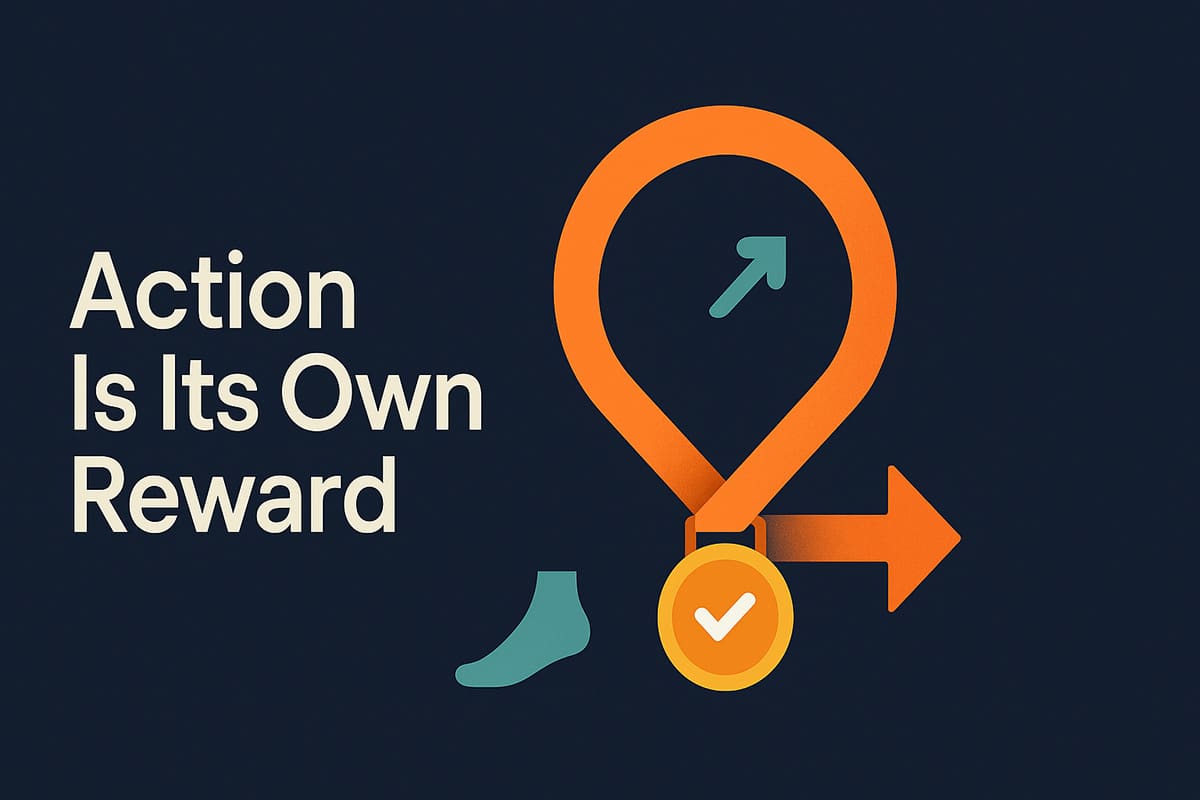
Welcome to the deepest secret of powerful leadership: When you stop needing results to validate your worth or success or feel happy, action becomes intrinsically rewarding. And paradoxically, that’s often when you get your best results.
The Body: You feel alive in your skin. Movement becomes play instead of work. You take care of your body because it feels good, not to impress others. You eat when hungry, rest when tired. Your body becomes your friend instead of your project.
The Heart: Love flows naturally because you’re not needing anything back. You listen because listening is fulfilling. You care about people genuinely, not to get approval. You do not want anything, so you naturally focus on others and give.
The Mind: Fresh thoughts arise instead of the same repetitive patterns. You think from spaciousness instead of anxiety. Creative and out of the box solutions appear naturally.
Identity: You know who you are beyond your role, title or company. You don’t need to defend an image or prove your worth. You’re comfortable being nobody special. You realise that “who you are” (not who you think you are) – it never changes, no matter what happens.
Business: Work becomes service instead of hustle and grind. You create because you care about what you’re building. Decisions come from clarity instead of fear. You commit fully to what’s in front of you without desperately needing specific outcomes.
Relationships: You connect at a deeper level because you recognize the same presence in others that you’ve found in yourself. You’re not using people to fill your emptiness. You can be alone without loneliness.
The key shift: instead of using the current ACTION you are doing to get to a better moment, you find you already have it all in this moment itself.
From that fullness, action becomes what Michael Singer calls “Karma Yoga” – selfless service that happens naturally because you’re no longer operating from lack.
Here’s the counterintuitive truth – when you stop desperately trying to force outcomes, you often achieve better outcomes.
Think about it – when you’re anxious about a presentation, how much of your mental energy goes into worrying versus actually preparing?
When you’re desperately networking to get something from people, how authentic and compelling are you?
When you commit fully to the task in front of you without attachment to results, you bring your whole being to it.
Athletes know this – their best performances happen when they’re completely absorbed in the game, not thinking about winning.
The same applies to leadership.
It’s not magic; it’s simply that undivided attention and authentic engagement are more powerful than scattered, needy effort.
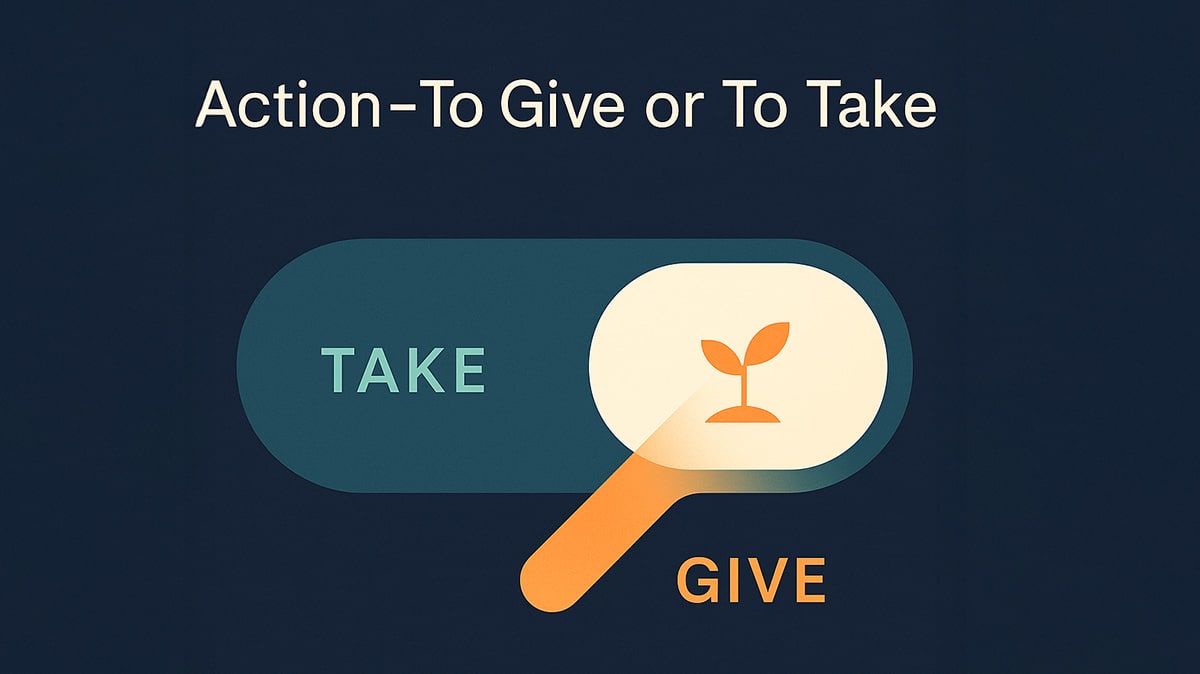
The Hidden Exhaustion of Transactional Leadership
Let me ask you something: When was the last time you made a leadership decision without some part of you calculating what you’d get in return?
I’m not talking about business ROI—that’s just good sense. I’m talking about the psychological payoff.
The need for your team to think you’re brilliant. The desire for investors to see you as visionary or your company as being on the right path. The hunger for industry recognition or appearing like the credible expert. The desperate hope that this quarter’s results will finally prove you belong in the C-suite.
This is what I call transactional leadership—every action is a transaction designed to get you something you think you need to feel okay about yourself.
Here’s the brutal truth: It’s exhausting as hell. Because you’re never actually present to what you’re doing.
You’re always projecting forward to some imagined payoff, some external validation that’s supposed to make you feel good about yourself.
and you do the projection because you are coming from some past fear, worry, or story that is not true but real for you in this moment.
But here’s what I’ve discovered working with hundreds of leaders: You can’t extract self-worth from external circumstances. It doesn’t work. You can hit every target, exceed every expectation, get every accolade, and still feel that gnawing sense that something’s missing.
That’s because the thing that’s missing isn’t in your next achievement. It’s in your relationship with the action itself.
When Action Becomes Its Own Reward
Think about the last time you helped someone without any agenda. Maybe you saw a colleague struggling with a problem and just naturally offered a solution. Or you noticed your team was overwhelmed and quietly took something off their plate.
How did that feel? There was something inherently satisfying about the action itself, wasn’t there? You weren’t calculating what you’d get in return. You saw what was needed and you provided it, and something in you felt fulfilled just from the doing.
That’s action as its own reward. And it’s available to you in every moment of leadership, not just the obviously altruistic ones.
Michael Singer, in his talks on Karma Yoga, describes this beautifully: When you’re not trying to extract something from each moment to fix your internal discomfort, you naturally become present to what the moment actually needs. And serving that need becomes inherently fulfilling, regardless of outcomes.
This isn’t some spiritual bypass or feel-good philosophy. This is practical leadership wisdom that changes everything about how you operate.
The Natural Leader in Action
Let me show you what this looks like when leaders actually embody it.
When the Action Itself Becomes the Reward
Jyoti, a SaaS founder, was facing her toughest board meeting yet. Revenue was soft, and she knew her investors wanted to hear about aggressive expansion plans. Her old self would have crafted a presentation designed to manage their reactions and keep them happy.
But something had shifted in Jyoti. She was aware of her relationship with validation and approval. She realized she was exhausted from using every interaction to prove her worth as a CEO.
So she walked into that meeting with a different intention entirely. Instead of asking “How do I look good here?” she asked “What does this situation actually need from me?”
The answer was uncomfortable: complete honesty about the challenges they were facing and her recommendation to focus on fundamentals instead of flashy growth metrics.
“I know you want to see aggressive expansion,” she told her investors, “but I think that would actually hurt our long-term value. We haven’t solved retention yet in our home market.”
As she spoke, something remarkable happened. She wasn’t nervous about their reaction. She wasn’t calculating how to spin the message. She was simply present to giving them what they actually needed to know, regardless of how it made her look.
The reward wasn’t their approval (though they eventually came around). The reward was the integrity of the action itself—finally being able to show up as a leader who served the situation instead of her own psychological needs.
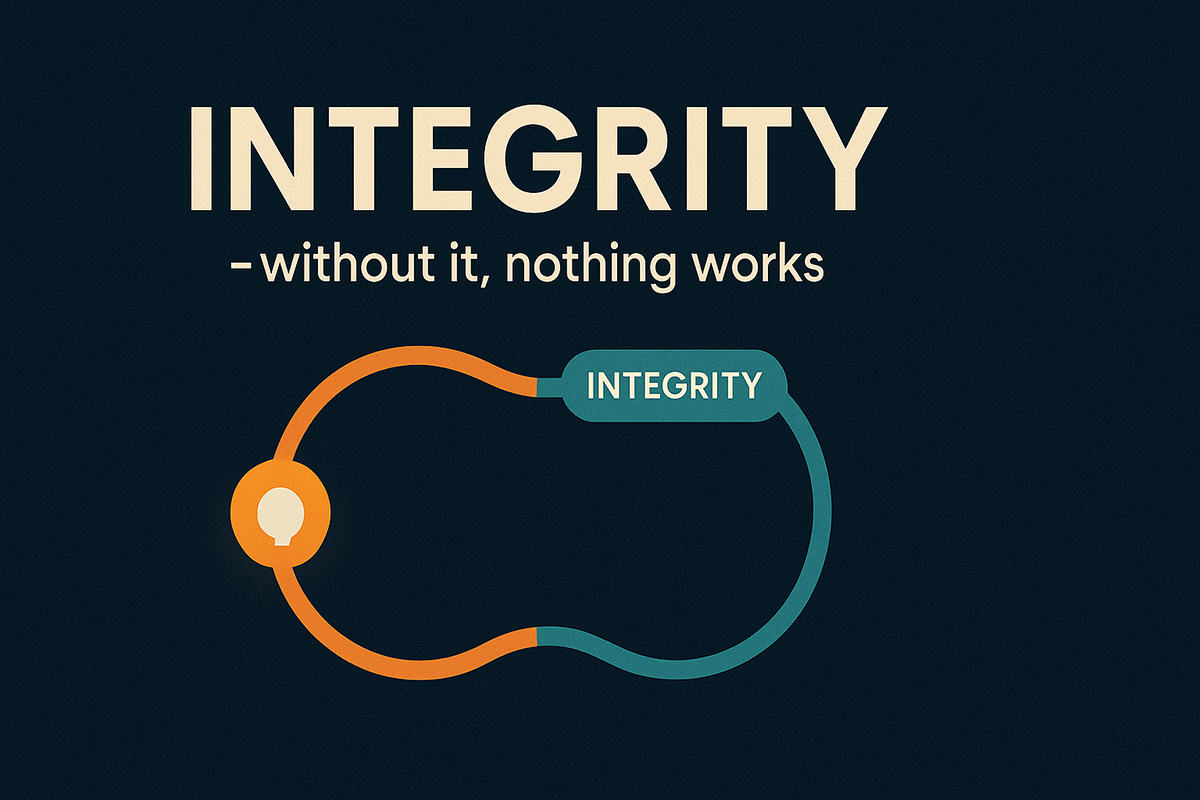
Every time you act in integrity with your Dharma, values, or your commitment – you are teaching yourself and others that you are someone who can be counted upon to do what they say and live by their values.
Every time you DO NOT act in integrity with your Dharma, values, or your commitment (irrespective of your reason or circumstances) – you are teaching yourself and others that you are someone who CAN NOT be counted upon to do what they say and live by their values.
This is why INTEGRITY is everything.
When Vulnerability Becomes Its Own Gift
Steve, a first-time CEO, had been drowning in imposter syndrome for months. Every meeting was an elaborate performance designed to hide his inexperience. The stress was killing him, but he was afraid that showing any weakness would undermine his authority.
Until one board meeting when something shifted. Instead of spending energy managing his image, he found himself genuinely curious about what the present situation needed from him.
The answer was startling: it needed his honesty.
“I have to tell you something,” he said, his heart pounding. “I’m terrified. This is my first time running a company at this scale, and half the time I have no idea what I’m doing. But I care about this mission too much to let my fears make our decisions.”
As the words left his mouth, Steve felt something he hadn’t experienced in months: relief. Not because of how anyone reacted (he couldn’t even see their faces through his vulnerability), but because he was finally doing what felt true instead of what felt safe.
The action of authentic leadership became its own reward. The fact that his team started trusting him more, that his investors appreciated his honesty, that his stress levels plummeted—those were just bonuses.
When Saying No Becomes an Act of Service
A consulting firm was offered a lucrative contract that would have solved their cash flow issues. The only problem? The client’s values completely contradicted everything the founder stood for. Easy money or integrity?
Her old self would have rationalized it: “We need the money,” “Maybe I can influence them from the inside,” “Business is business.” But the founder had been journaling her own thoughts as an awareness exercise. So she wasn’t desperate for approval or financial security in the way she used to be as she was actively writing her insecure thoughts every day in a journal.
So when she looked at the situation, the answer was obvious: “I can’t work with you. Your practices harm the exact people we’re trying to help.”
The reward wasn’t the three new clients who reached out because of her public stance (though that was nice). The reward was the action itself—finally being able to operate from her values instead of her fears.
Her team felt it immediately. They started working with a passion she’d never seen because they knew their leader was making decisions based on what mattered, not what paid.
Your Dharma: The Commitment That Calls You
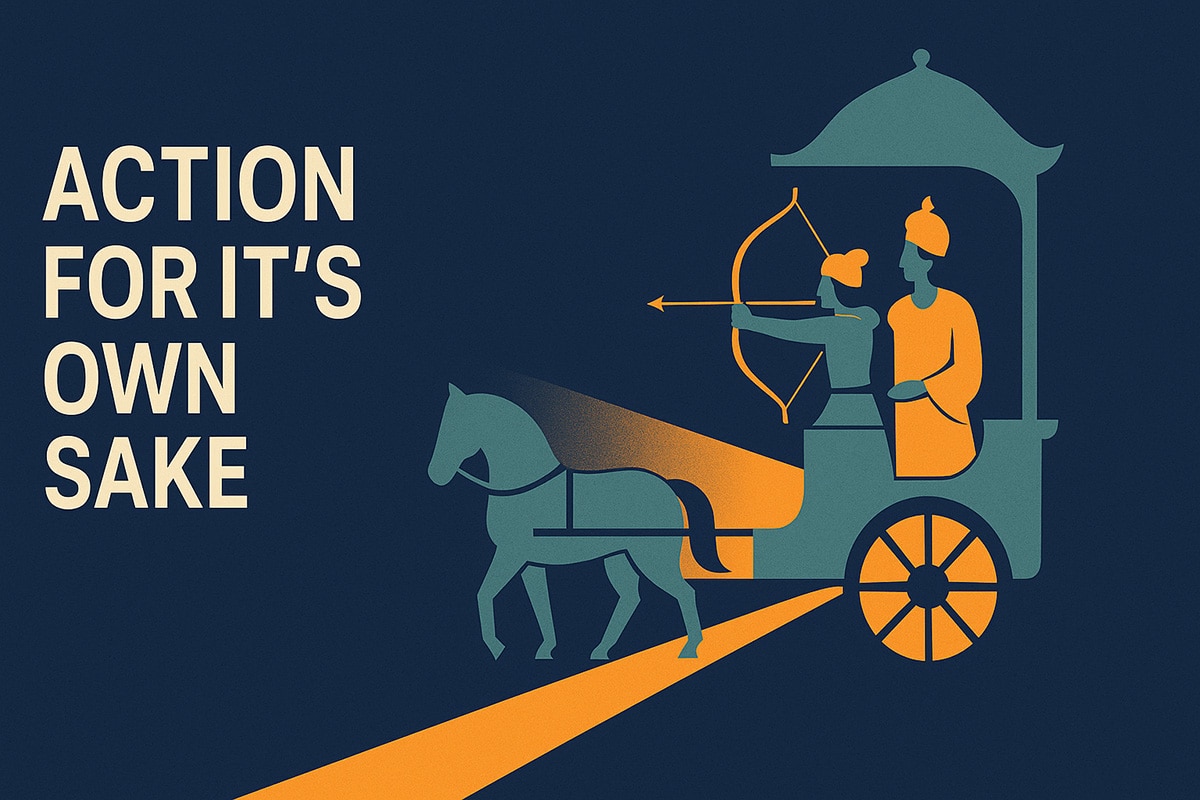
The Bhagavad Gita, the ultimate text on this philosophy, tells the story of a warrior named Arjuna who’s having a complete meltdown right before the most important battle of his life. He’s questioning everything—his role, his qualifications, whether he deserves to be there.
His guide Krishna gives him the most practical leadership advice ever: “Stop making this about your personal drama. You’ve trained your whole life for this moment. This situation needs your specific skills. The reward isn’t what you’ll get from fighting—the reward is the privilege of being able to serve in the way only you can.”
Your dharma—your deepest commitment—isn’t something you do to get something else. It’s the thing you’re called to do because you’re uniquely positioned to do it and you have committed to it, and the doing itself is inherently meaningful.
For me, this became clear when I left my tech career. I wasn’t trying to become a leadership coach to build some identity or prove anything to my family. In fact, it was the opposite as it looked like career suicide.
I just looked at what was happening—brilliant people burning out, companies struggling with toxic cultures, leaders performing instead of leading—and realized I wanted to contribute to a different possibility. And I was actually good at it.
The work itself became the reward. The fact that it’s also financially sustainable and personally fulfilling is gravy.

The Paradox of Detached Yet Fully Committed Action
Here’s where this gets really interesting for results-oriented leaders: When you stop being attached to specific outcomes, you often achieve better results than when you were desperately chasing them.
Don’t try to make sense of it. Because it doesn’t make sense. It is a paradox.
Why does that happen? Because your actions are finally aligned with reality instead of your psychological needs.
You’re not distorting information to protect your ego. You’re not avoiding difficult decisions to manage your anxiety. You’re not pushing strategies that make you look good instead of strategies that actually work. You’re not saying what people want to hear instead of what they need to hear.
When action becomes its own reward, you can afford to be completely honest about what each situation requires, because your self-worth isn’t riding on any particular outcome.
This is the ultimate leadership superpower: the ability to act with complete commitment while being unattached to results. You care deeply about doing the right thing (based on your commitments), but your identity isn’t dependent on any specific outcome.
The Practice: Finding the Reward in the Doing
This isn’t about becoming some zen master who doesn’t care about results. In fact, your commitments are often derived from the future results that you want to see.
It’s about changing your relationship with action so that you can actually be more effective.
Here’s how to start:
Before any leadership decision or interaction, pause and ask yourself: “What do I need from this moment?” Notice what comes up. Recognition? Control? Validation? Proof that you belong?
Then ask: “What would I do here if the action itself was the only reward I could get?”
OR
“What would serve this moment and situation best given my Dharma and commitment?”
That second question will show you what aligned action looks like – and what your real commitments (or Dharma) are.
Sometimes it means having conversations that make people uncomfortable because that’s what serves the situation. Sometimes it means admitting you don’t know something because honesty serves better than pretense.
Sometimes it means making decisions that look risky on paper because they align with your deeper values. Sometimes it means turning down opportunities that don’t feel authentic to who you’re becoming.
None of this requires you to be selfless or sacrifice your needs. It just requires you to stop outsourcing your fulfillment to external circumstances and start finding it in the integrity of your actions.
When Teams Feel the Difference
Something beautiful happens when you start leading from this place: everyone around you relaxes.
Your team stops managing your emotional reactions because you’re not using meetings to regulate your self-esteem. Your peers stop competing with you because you’re not trying to prove you’re better than anyone. Your investors trust your judgment more because your decisions serve the company instead of your image or just a relationship. Your family gets the real you because you’re not carrying the stress of constantly performing.
People can feel when you’re not trying to extract something from every interaction. It creates psychological safety that allows everyone to focus on the actual work instead of managing these hidden dynamics.

The Ultimate Leadership Freedom
Here’s what I’ve learned from studying ancient wisdom and working with modern leaders: The most powerful thing you can do is stop needing your leadership role to provide you with anything other than the opportunity to serve.
When you find fulfillment in the action itself – in the privilege of being able to contribute your gifts to something meaningful – you become unstoppable. Not because you don’t care about results, but because you’re no longer distorting your actions to achieve results that feed your ego.
You can take bigger risks because failure doesn’t threaten your identity.
You can have harder conversations because you don’t need everyone to like you. You can make unpopular decisions because your self-worth isn’t dependent on approval. You can be completely honest because you’re not protecting any image.
This is what it looks like to lead from your natural power instead of your compensated weaknesses.
The Bottom Line: The Doing Is the Reward
Most leaders are waiting for some future result to make them feel fulfilled. The next funding round. The next promotion. The next acquisition. The next quarter that finally proves their worth.
But what if fulfillment was available right now, in whatever action this moment is asking you to take?
What if you could find the same satisfaction in a difficult conversation that serves your team’s growth as you do in hitting a revenue target?
What if you could feel as rewarded by the integrity of turning down a bad opportunity as you do by landing a good one?
What if the action of leadership itself—showing up fully, serving what’s needed, contributing your gifts—was enough?
That’s not a philosophical concept. That’s a practical way of being that’s available to you in every moment of every day.
The world doesn’t need more leaders who are performing for external validation. It needs leaders who are so fulfilled by the work itself that they can afford to do what actually serves, regardless of how it makes them look.
You have everything you need to be that leader right now. The question is: Are you willing to stop using your role to fix your internal stuff and start using it to contribute what only you can give?
The action that is aligned to your Dharma and commitment is waiting. And it’s its own reward.
Leave a Reply