
Here’s What I’ve Seen Working Across Four Continents
I grew up in India, spent 16 years in tech, worked with companies across the US and UK for two decades, briefly experienced Japanese culture at Yahoo, and now live in the Netherlands.
And everywhere I go, I see the same thing happening. Over the past few years, we’ve slowly drifted into something I no longer recognize as leadership. We started cushioning decisions, over-explaining expectations, softening feedback, adding rules instead of responsibility, and calling it “care.”
We took three beautiful ideas—diversity, inclusion, and empathy—and turned them into excuses for treating capable adults like fragile children who can’t handle reality.
I’ve watched it play out in a 70 year old organisation in Bangalore, a Fortune 500 in New York, a scale-up in Amsterdam, a consultancy in Dubai, and a tech giant in London.
Different languages. Different cultures. Same problem.
Let me tell you what I mean.
What Actually Happened
What it was meant to be: Teams with different perspectives making better decisions. Cultures where everyone can show up fully. Leaders who actually understand their people.
What we got: Leaders terrified to give honest feedback to anyone who might be “different.” Teams where nobody can say anything uncomfortable.
I’ve seen it everywhere. And I’m done pretending it’s working.
The Ten Ways I’ve Seen Leaders Treat Adults Like Children
Let me walk you through what this actually looks like. I’ve done some of these myself. I’ve watched others do all of them.
1. The Layoff Dance
What I’ve seen in the India, US and UK: CEOs know they need to cut 20% of the team. The numbers are clear. But they can’t pull the trigger because “people have families” and “it will devastate them.”
So they burn through six more months of runway, hoping for a miracle. When they finally do the layoffs, it’s worse – the founder plunges into guilt, people are blindsided, trust is destroyed, and the company barely survives.
What’s actually happening: You’re treating your team like children who can’t handle hard news. Adults with mortgages and kids? They can handle reality. What they can’t handle is you lying to them for six months.
2. The Underperformer Nobody Will Name
What I saw in India: There’s always that one person who’s been around “since the beginning.” They’re not performing. Everyone knows it. But because they’re “loyal” or because they’re a certain age or gender or background, nobody will say it directly.
Instead, there are “check-ins” and “coaching conversations” where leaders hint around the issue but never actually say: “Your work isn’t good enough.”
What I see in the Netherlands: Same thing, different excuse. Here it’s all about “giving people time to find their way.” Meanwhile, your best people are quietly updating LinkedIn because they’re tired of carrying dead weight.
What’s actually happening: You’re denying someone the gift of honest feedback. You think you’re being kind. You’re actually stealing others’ growth by not telling people what they need to hear to grow – and you’re losing your best people in the process.
3. The Brilliant Jerk Exception
What I learned at Yahoo: In Japanese culture, there’s a strong value on harmony and respect. Beautiful, right?
Except when there’s a technical genius who’s toxic to everyone around them. And because they’re so valuable, everyone just… works around them. Nobody confronts it directly.
What I’ve seen in the US: Same pattern, louder version. The star engineer who makes people cry. The top salesperson who undermines everyone. Leaders tell me, “We can’t lose them. They’re too good.”
What’s actually happening: You’re telling everyone else that performance matters more than being a decent human. You’re slowly bleeding your good people while protecting your toxic ones.
4. The Endless Meeting Problem
What I see in the Netherlands: The consensus culture here is real. Every decision requires input from everyone. Another meeting. Another workshop. Another brainstorming session. Meanwhile, decisions take forever and nothing moves.
What I saw in the US: Different flavor, same problem. “Everyone needs to feel heard.” “We need buy-in.” “Let’s make sure we’re all aligned.”
What’s actually happening: You’re avoiding your job as a CEO, which is to make decisions. Adults don’t need to agree with every decision. They need to know what the decision is and what’s expected of them.

5. The Feedback Sandwich
Everywhere I’ve worked: “You’re doing AMAZING work, truly incredible, but maybe there’s this tiny thing you could consider changing if you feel like it, but honestly you’re phenomenal!”
Person walks away thinking everything’s fine. You think you gave feedback.
What’s actually happening: You buried the message so deep, they didn’t get it. And you’ve trained them that your praise means nothing.
6. The Never-Ending Accommodation
What I’ve seen in India and the UK: Someone’s going through a hard time. So you adjust their workload. Then adjust again. And again. Six months later, the “temporary” accommodation is permanent, and their teammates are burning out picking up slack.
What’s actually happening: You think you’re being supportive. You’re actually enabling them to stay stuck. And punishing everyone else for being capable.
7. The Compensation Silence
What I grew up with in India: Money discussions were considered rude, inappropriate, not done. You don’t ask about salary. You don’t discuss raises. It’s all very hush-hush.
What I see globally now: Same pattern, different excuse. “We pay fairly” with no data. “Don’t discuss salaries” with no framework. People leave feeling disrespected because they have no idea where they stand.
What’s actually happening: You’re treating adults like children who can’t handle conversations about money. They can. They need to.
8. The “Unlimited Time Off” Nobody Takes
What I see in the US: Companies proudly announce unlimited vacation. Sounds great!
Except nobody knows what’s actually acceptable. The founder never takes time off. Anyone who takes more than two weeks gets weird looks.
What’s actually happening: You gave fake freedom with real pressure. Adults need clear expectations, not guessing games.
9. The “We’re All Equal” Lie
What I see in startups everywhere: Founders want to be “one of the team.” They downplay their authority. “I’m not the boss, just a teammate!” They act like every decision is democratic.
Meanwhile, everyone’s confused about who actually decides what.
What’s actually happening: You DO have more power. Pretending you don’t just creates anxiety. Adults can handle clear hierarchies.
10. The Vision Explanation Loop
What I’ve done myself: Explained the strategy. People asked questions. Explained again. More questions. Created another deck. More doubts. Had 1-on-1s. Still more questions.
I thought they weren’t getting it. I needed to explain better.
What was actually happening: Some people were never going to be excited about the direction. That was fine. I needed commitment, not people to agree on everything. I was wasting time on explanation instead of moving forward.
What I’ve Learned About Real Empathy
Here’s what nobody told me when I left my engineering career to coach CEOs as they create multi-generational impact and wealth:
Empathy isn’t taking on someone else’s feelings. Empathy is understanding their feelings AND trusting them to handle their own feelings.
When I was in India, I learned to be “nice” which meant avoiding conflict, protecting feelings, keeping harmony.
When I worked with people in the US, I learned to be “supportive” which meant managing emotions, creating comfort, being everyone’s cheerleader.
When I got to the Netherlands, I learned to be “inclusive” which meant endless consensus and never making anyone uncomfortable.
What nobody taught me: Sometimes the kindest thing you can do is refuse to rescue people from their own experience.
Real empathy says: “I see you’re struggling. I believe you can handle this. What support do you actually need?”
Fake empathy says: “You’re upset, so I’ll change everything to make you feel better because you clearly can’t handle discomfort.”
One respects people. The other treats them like children.
We All End Up Doing This Without Realising The Cost
We avoid difficult conversations to maintain relationships. Until “relationship” becomes code for avoiding accountability.
We preserve harmony at all costs. Until “harmony” means nobody can say what’s actually wrong.
We build consensus endlessly. Until “consensus” means nothing ever gets decided.
We want everyone to feel valued. Until “valued” means protected from any discomfort.
We’re polite and indirect. Until “polite” means nobody knows where they actually stand.
Different cultures. Different reasons and patterns. Same result: Leaders too scared to lead.
What Leadership Actually Needs to Look Like
I’ve learned this the hard way, in multiple countries, multiple companies, multiple failures:
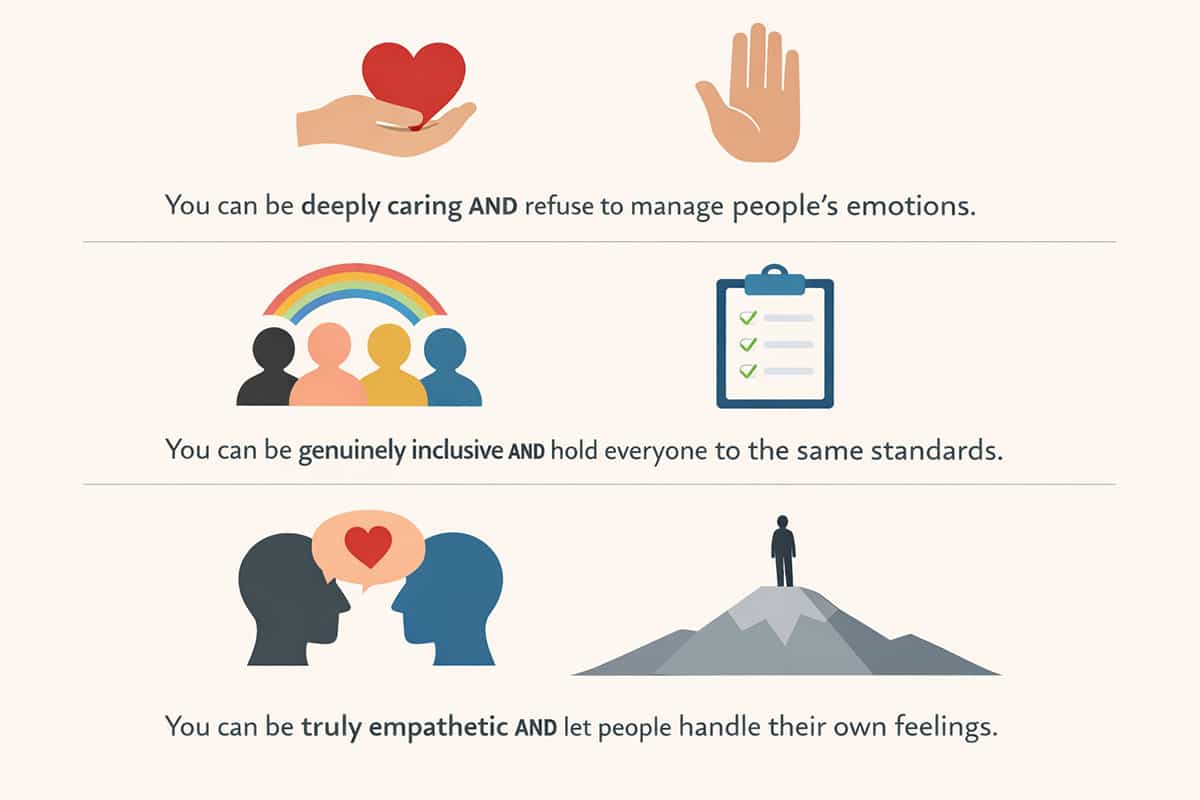
You can be deeply caring AND refuse to manage people’s emotions.
You can be genuinely inclusive AND hold everyone to the same standards.
You can be truly empathetic AND let people handle their own feelings.
Here’s what it actually sounds like:
“I hear that you’re frustrated with this decision. That makes sense. It’s a big change. AND the decision stands. Here’s what I can offer: clarity on the reasoning and support in adapting to it. Here’s what I can’t offer: changing the decision or managing your feelings about it. How do you want to move forward?”
That’s not cold. That’s respectful.
You’re acknowledging their experience without taking it on. You’re holding your line while staying human. You’re treating them like an adult who can handle reality.
The below is an email one CEO I coached sent to his entire company which led to explosive growth after a few years of stagnancy and slow growth:
“From now on, personal responsibility in this company means:
- You own your role end-to-end.
Not just the effort. Not just the intent. The result. - You speak up early.
If something isn’t working, say it before it becomes a problem. Silence is no longer neutral. - You ask for clarity, not comfort.
If expectations aren’t clear, ask. If feedback is hard, take it. Growth is not gentle. - You keep your agreements.
If you can’t, you say so—early—and renegotiate. Broken promises erode trust faster than mistakes. - You manage yourself.
Your energy, reactions, and professionalism are your responsibility—not your manager’s.
Leaders, including me, are not stepping back. We are stepping up differently from now on.
- We will be direct, not vague.
- We will set clear standards, not moving goalposts.
- We will give honest feedback, not emotional padding.
- We will back people who take responsibility and challenge those who don’t.”
The CEO was building something serious and they finally started demonstrating that commitment in action – with people who choose to act like it.
The Truth Nobody Wants to Say
When you stop managing people’s emotions, you actually create the most inclusive environment possible.
Because you’re saying:
- Everyone gets honest feedback (real equality)
- Everyone is held to the same standards (true inclusion)
- Everyone is trusted with difficult information (actual respect)
- Everyone is seen as capable (genuine empathy)
The “empathy” that means walking on eggshells and treating people differently based on their identity? That’s not inclusion. It’s condescending.
What I Know Now
After working across India, the US, Netherlands, UK, the middle-east and Japan, here’s what I know for sure:
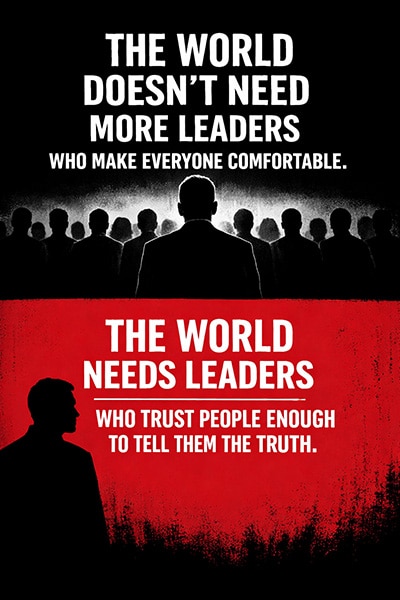
The world doesn’t need more leaders who make everyone comfortable.
The world needs leaders who trust people enough to tell them the truth.
Leaders who care enough to hold boundaries.
Leaders who respect people enough to let them handle their own feelings.
Leaders who love people enough to refuse to treat them like children.
From Bangalore to Boston, from Amsterdam to London, from Tokyo to anywhere else – the challenge is the same.
Stop protecting people from reality and calling it kindness.
Start trusting their capability. That is your leadership.
That’s what I’m committed to. That’s what I help leaders do.
That’s what actually changes workplaces from places that make people sick to places that help people grow.
And that’s what you and I both know needs to happen.
The only question is: Are you ready to stop playing nice and start leading for real?
Leave a Reply