
The three levels of internal communication that turn confusion into alignment
A CEO I’ve been working with recently told me something that I have heard too many times.
“I’ve explained our strategy at least five times this quarter,” she said. “Town halls. Leadership meetings. Email updates. But when I ask people what we’re doing and why, I get five different answers.”
She wasn’t angry. She was exhausted.
“I don’t know how to say it any clearer,” she said.
Here’s what I told her: You’re probably being perfectly clear. You’re just not being meaningful.
And there’s a big difference.
Most leaders communicate strategy the way they’d present a quarterly business review—lots of what, not much why, and almost no so what.
They talk about initiatives, KPIs, market positioning, and organizational priorities.
All important. All necessary.
And all completely forgettable.
Because here’s the truth: people don’t align around strategy. They align around meaning.
And meaning doesn’t come from telling people what you’re doing. It comes from helping them understand what it does—for them, for the customer, for the mission they signed up for.
The same three levels of communication that transform how you talk to customers? They’re even more powerful when you use them internally.
Let me show you how.
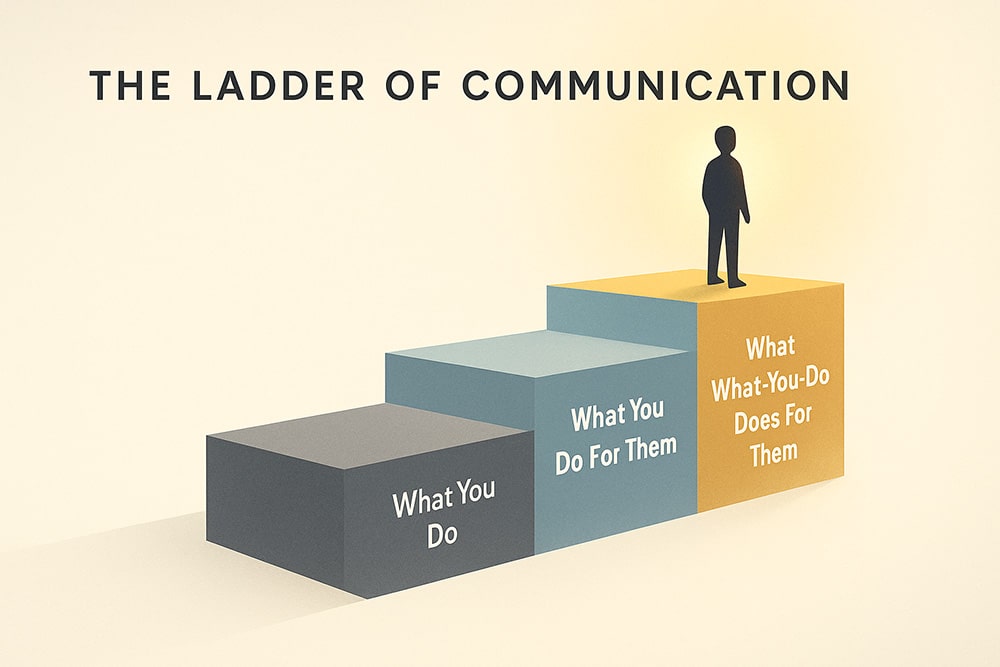
Level 1: What We’re Doing
This is where most internal communication lives.
It’s the initiative. The project name. The reorganization. The new system rollout.
- “We’re launching a digital transformation initiative.”
- “We’re restructuring the sales org.”
- “We’re implementing a new CRM.”
- “We’re focusing on operational excellence this year.”
It’s accurate. It’s what’s happening.
But it doesn’t tell anyone why they should care.
When you communicate at Level 1 internally, you get compliance, not commitment. People nod in the meeting. They add it to their task list. But they don’t feel connected to it.
The result? Passive execution. Minimal discretionary effort. And when things get hard, people quietly disengage.
Because you’ve told them what to do. You haven’t told them why it matters.
Level 2: What We’re Doing For Them
This is where leaders start to create relevance.
Instead of just announcing the initiative, you connect it to the people executing it. You make it personal.
- “We’re launching a digital transformation so teams can spend less time on manual processes and more time on work that actually moves the needle.”
- “We’re restructuring the sales org so reps have clearer territories and more support from leadership.”
- “We’re implementing a new CRM so you’re not juggling three different systems just to update a customer record.”
- “We’re focusing on operational excellence so we can deliver faster, reduce firefighting, and stop working weekends.”
See what changed?
You’ve given people a reason to care. You’ve shown them what’s in it for them.
Suddenly, it’s not just another corporate initiative. It’s something that could make their day-to-day better.
Why it works: People support what they understand. And they understand what connects to their reality.
But even this isn’t enough to create true alignment.
Level 3: What What-We’re-Doing Does For Them
This is where strategy becomes a shared mission.
It’s not just what you’re doing for them. It’s what that outcome enables in their work, their impact, their sense of purpose.
Let’s push those examples deeper:
- “We’re launching a digital transformation so teams can spend less time on manual processes” becomes → “We’re doing this so you can focus on the work that made you want to join this company in the first place—solving real problems for customers, not wrestling with spreadsheets.”
- “We’re restructuring the sales org so reps have clearer territories” becomes → “We’re doing this so you can build real relationships with your accounts, win deals you’re proud of, and finally feel like you’re building something—not just hitting a number.”
- “We’re implementing a new CRM so you’re not juggling systems” becomes → “We’re doing this so you can serve customers the way you’ve always wanted to—fast, informed, and without having to put them on hold while you dig through three different databases.”
- “We’re focusing on operational excellence so we can deliver faster” becomes → “We’re doing this so you can go home at a reasonable hour, trust that your work won’t unravel overnight, and feel proud of what we’re building together.”
This is the level where people stop seeing strategy as a thing being done to them and start seeing it as something they’re part of.
This is where discretionary effort lives. Where people go the extra mile. Where teams rally during tough moments.
Because you’ve connected the what to the why—and the why to something they actually care about.
Why This Matters More Than Ever
Here’s what I see all the time: CEOs pour energy into crafting the perfect strategy. They workshop it with their leadership team. They refine the slides. They get the messaging just right.
And then they roll it out like a product launch.
They present it once. Maybe twice. And then they move on.
And six months later, they’re frustrated because “people just don’t get it.”
But here’s the thing: clarity isn’t a one-time event. It’s a drumbeat.
And the drumbeat has to be meaningful, not just informative.
People don’t align around a deck. They align around a story they can see themselves in.
When you communicate at Level 3, you’re not just explaining strategy. You’re giving people a reason to care. A reason to show up. A reason to stay when things get hard.
How to Do This in Practice
Here’s how to apply this framework to your internal communication:
1. Start with the announcement (Level 1)
State what you’re doing clearly and concisely. Don’t skip this. People need to know the what.
“We’re launching a new performance management system.”
2. Add the practical benefit (Level 2)
Connect it to their day-to-day. Make it relevant.
“This system will replace the clunky process we’ve been using, so reviews are faster and less painful for everyone.”
3. Go to the emotional core (Level 3)
Paint the picture of what this enables.
“We’re doing this so people actually get the feedback they need to grow—not just once a year in a stressful meeting, but ongoing, in real time, in a way that feels supportive. So you can build your career here, not just survive it.”
Real Examples from Leaders Who Got It Right
A manufacturing CEO announcing a safety initiative:
- Level 1: “We’re implementing new safety protocols across all facilities.”
- Level 2: “These protocols will reduce accidents and protect you and your teammates.”
- Level 3: “We’re doing this so every single person here goes home to their family every night—no exceptions, no close calls. Because nothing we build is worth more than that.”
A tech CEO rolling out a new customer service platform:
- Level 1: “We’re adopting Zendesk for customer support.”
- Level 2: “This will give you better tools to respond to customers faster and track issues more easily.”
- Level 3: “We’re doing this so you can finally give customers the experience you’ve always wanted to give them—where nothing falls through the cracks and you’re the hero who actually solved their problem.”
A nonprofit executive director announcing a strategic pivot:
- Level 1: “We’re shifting our focus from direct services to advocacy.”
- Level 2: “This means we’ll be working on systemic change rather than individual case management.”
- Level 3: “We’re doing this so the work you do doesn’t just help one person today—it changes the system so thousands of people get the support they deserve, for years to come. So your effort compounds.”
In every case, the leader took the same journey: from what do we do to what that does for them.
And in every case, people leaned in.
What Changed for My CEO Client
When I walked that CEO through this framework, something clicked.
She realized she’d been communicating like a strategist when her team needed her to communicate like a leader.
She wasn’t lacking clarity. She was lacking connection.
So she tried something different.
At her next town hall, she didn’t just explain the strategy. She explained what it would do—for customers, for the team, for the mission they’d all signed up for.
She didn’t just talk about growth targets. She talked about what growth would enable: more investment in people, better tools, less chaos, more impact.
And for the first time in months, she said, people didn’t just nod politely.
They asked questions. They pushed back. They engaged.
Because for the first time, they understood not just what they were doing—but why it mattered.
The Bottom Line
If your strategy isn’t landing, it’s probably not because people don’t understand it.
It’s because they don’t feel it.
And feelings don’t come from org charts or initiative names.
They come from meaning. From connection. From understanding what this does for me, for us, for the work we care about.
When you master these three levels of internal communication—from what we’re doing, to what we’re doing for you, to what that enables—you stop managing and start leading.
You stop explaining and start inspiring.
And you stop wondering why people aren’t aligned.
Because they finally are.
give it a go in your next all-hands. You’ll feel the difference.
Leave a Reply