
We all do this – Talk Ourselves Out of Our Commitments
And that’s exactly what we need to talk about.
If you’ve just had a powerful conversation with me about your future—the one that made your heart race and your mind light up with possibility—I need you to know something important: you’re probably going to talk yourself out of it.
Not because you don’t want it (the new possibility). Not because it’s not right for you. But because your brain is about to do what brains do when faced with something bigger than they’re used to: protect you from what it perceives as danger.
I’m writing this because I’ve seen it happen hundreds of times. Someone leaves our call feeling electric, inspired, clear about what they want to create. Then, 24 to 48 hours later, the doubts creep in. The “what ifs” start multiplying. The practical concerns suddenly seem insurmountable.
And if I don’t hear from them, I know exactly what’s happening. They’re sitting at their kitchen table or in their car, having a mental wrestling match with themselves. They’re building a case for why now isn’t the right time, why they should wait, why they need to be more prepared.
We all talk ourselves out of our dreams and commitment. And we always have good reasons for that.
Here’s what I want you to know is:
- This is not a character flaw
- This is not weakness. There is nothing wrong with you.
- This is not a sign that you’re not ready or that the dream isn’t real
- This is your nervous system doing exactly what it was designed to do—keep you safe and comfortable
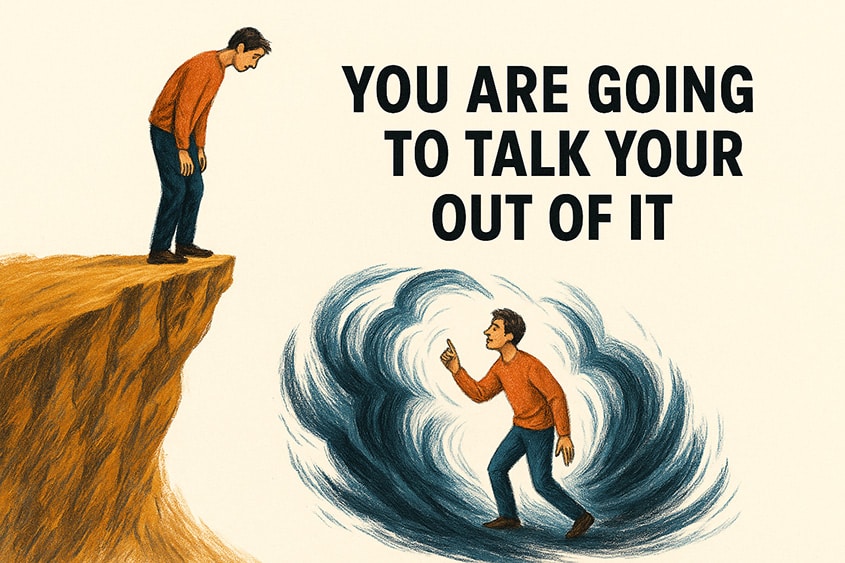
Your Brain Doesn’t Know the Difference Between a Tiger and a Dream
Let me tell you about Shruti, a tech company CEO who came to me feeling stuck. She’d been in the same role for three years, comfortable but unfulfilled. She had a vision of starting her own consulting firm, helping companies build more human-centered cultures. When we talked, her eyes lit up. She could see it all—the clients she’d work with, the impact she’d make, the freedom she’d have.
Two weeks later, she hadn’t returned my call.
When we finally connected, she was embarrassed. “I got scared,” she admitted. “I started thinking about everything that could go wrong. What if I can’t get clients? What if I fail? What if I’m not as good as I think I am?”
Her brain couldn’t tell the difference between a sabre-toothed tiger and starting a consulting firm. Both triggered the same ancient alarm system: DANGER. THREAT. RETREAT.
Your brain evolved in a world where taking big risks often meant death. The person who decided to explore that dark cave might have found food—or they might have become food. The brain that kept humans alive was the one that said, “Better safe than sorry.”
That same brain is now trying to keep you “safe” from your dreams. It’s flooding you with cortisol and adrenaline, making you feel anxious and overwhelmed. It’s not trying to sabotage you—it’s trying to save you.
The Committee Meeting in Your Head
After a coaching conversation (sometimes even a regular conversation) with me – especially if you find it insightful or powerful, something predictable is going to happen. Your brain is going to call a committee meeting. And this committee is not your friend.
The committee members include:
• The Accountant: “Do you know how much this costs? You could use that money for so many other things. What about the roof? What about retirement? This is irresponsible.”
• The Comfort-Seeker: “You’re already so busy. Do you really want to add more stress to your life? Things are fine the way they are. Why rock the boat?”
• The Inner Critic: “Remember when you tried that other thing and it didn’t work out? You’re not disciplined enough for this. You’re going to disappoint everyone, including yourself.”
• The Social Worrier: “What will your spouse think? Your friends? Your colleagues? They’ll think you’re going through a midlife crisis. They’ll think you’re being frivolous.”
This committee’s job is to maintain the status quo. They’re not interested in your growth or your dreams. They’re interested in keeping everything exactly as it is, because that feels safe.
And here’s the kicker: they’re going to make very logical, rational-sounding arguments.
They’re not going to say, “Don’t do this because you’re scared.”
They’re going to say, “Don’t do this because it’s financially irresponsible” or “Don’t do this because the timing isn’t right.”
PS – The committee is just a dramatic name for your brain and nervous system.
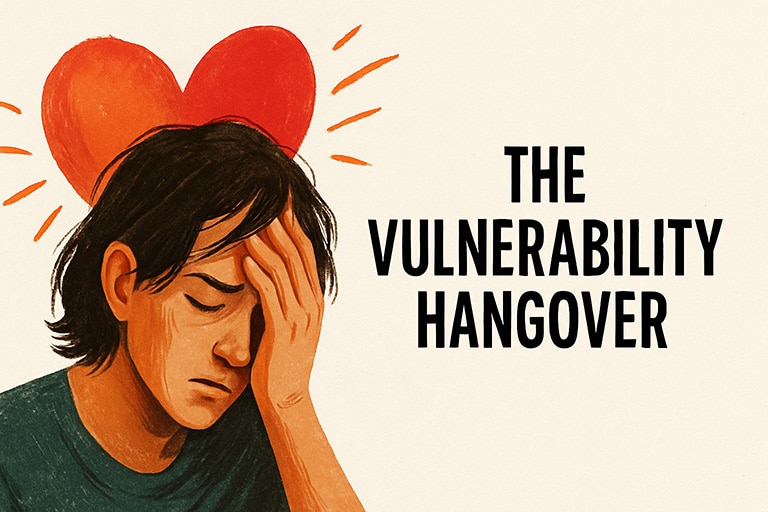
The Vulnerability Hangover
Let me tell you about Marcus, a successful lawyer who came to me feeling empty despite his achievements. In our session, he shared something he’d never said out loud: he wanted to write a book about his experience growing up in foster care and how it shaped his drive to help others.
He left our call feeling alive, purposeful, clear. Three days later, he was mortified. “I can’t believe I told you that,” he said. “I sound like such a cliché. A lawyer who wants to write a book? How original.”
This is what I call the vulnerability hangover. When you share your deepest dreams with someone, you’re being incredibly vulnerable. In the moment, it feels amazing—like you’re finally being seen for who you really are. But later, when the emotional high fades, that vulnerability can feel terrifying – like a hangover.
Your brain starts saying:
- “Why did you tell them that? Now they know.”
- “What if you can’t do it? What if you fail?”
- “You’ll look like a fool.”
The easiest way to deal with this discomfort is to distance yourself from the person who witnessed your vulnerability.
If you avoid me, you can avoid the reminder of what you shared. You can avoid the accountability. You can avoid the possibility of disappointment.
But you can not avoid that dream that you have hiding and holding down for years – sometimes even for – decades.
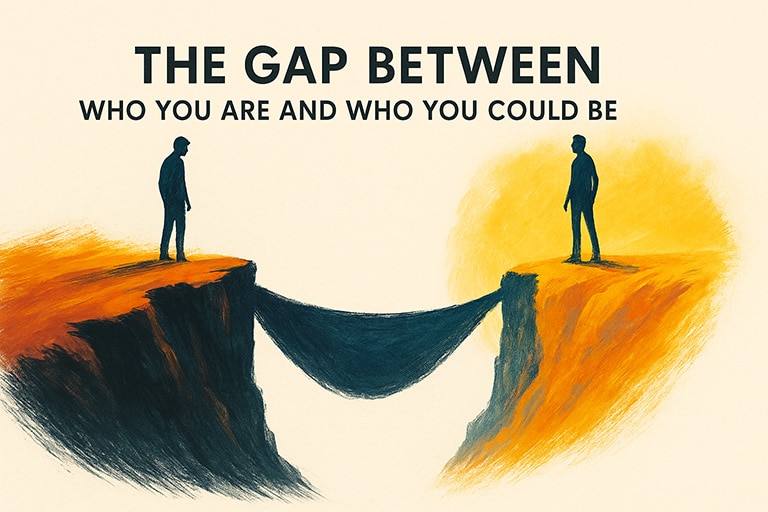
The Gap Between Who You Are and Who You Could Be
Here’s what’s really happening: in our conversation, I helped you see a version of yourself that’s bigger than your current reality. I held up a mirror that showed not who you are today, but who you could become.
This creates what I call the “aspiration gap“—the space between your current self and your potential self. This gap is both incredibly exciting and absolutely terrifying.
On one hand, it’s thrilling to see what’s possible. On the other hand, it’s overwhelming to think about all the changes you’d need to make to get there.
Let me tell you about Jennifer, a marketing director who came to me feeling burned out. She had a vision of creating a more balanced life, maybe even starting her own agency. When we talked, she could see it all clearly. But a week later, she was paralyzed.
“I was so excited on our call,” she told me. “But now I’m looking at my life and I don’t know how to get from here to there. It feels impossible.”
Jennifer wasn’t backing away from her dream. She was backing away from the seemingly impossible journey between where she was and where she wanted to be.
What I Want You to Know About Me
If you’re reading this and feeling called out, if you’re recognizing yourself in these stories, I need you to know something important: I am the last person you need to worry about disappointing.
Here’s what I’m NOT here to do:
- to judge you
- to be disappointed in you
- to make you feel guilty or ashamed
- to keep score of your progress
- to wait for you to prove yourself
Here’s what I AM:
- Someone who’s been where you are
- Your thinking partner and reality check
- Your reminder of what’s possible
- Here to help you take the next step
- Someone who will never judge you
- Someone who will never give up on you
- Someone whom you can always count on
I’ve been where you are. I’ve had the dreams that seemed too big, the visions that felt too scary to pursue. I’ve felt the vulnerability hangover after sharing something deeply personal. I’ve had my own committee meetings where every logical voice said, “Don’t do it.”
When I decided to leave my lucrative tech career to become a coach (which took me 8 years), my own brain went into overdrive. “You’re giving up a sure thing for what? To help people? That’s not a real job. You’re being irresponsible. You’re going to fail.”
I almost talked myself out of it a dozen times. The only difference is that I had someone in my corner who understood what was happening—someone who helped me see that the fear was not a stop sign but a sign that I was onto something important.
I’m that person for you now.
The Fear Is Not the Enemy
Here’s what I’ve learned: the fear you’re feeling isn’t a bug in the system—it’s a feature. It’s your brain’s way of saying, “This matters. This is important. This could change everything.”
The bigger the dream, the bigger the fear. If you weren’t scared, it would mean the goal wasn’t significant enough to trigger your growth edge.
Let me tell you about Ahmed, a CEO who came to me wanting to transform his company culture. He had a vision of creating a workplace where people actually wanted to be, where they felt valued and heard. In our session, he was passionate, clear, committed.
A week later, he was second-guessing everything. “Maybe I’m being too idealistic,” he said. “Maybe this is just how business works. Maybe I should focus on the numbers and leave the touchy-feely stuff alone.”
“Ahmed,” I said, “if this were easy, if it didn’t scare you, would it be worth doing?”
He was quiet for a long moment. Then: “No. If it were easy, someone would have done it already.”
The fear wasn’t telling him to stop. It was telling him he was onto something that mattered.
What to Do When the Committee Convenes
So what do you do when the committee in your head starts its meeting? When the doubts creep in and the excuses start forming?
Your Four-Step Process:
- Expect it. Don’t be surprised when it happens. Say to yourself, “Oh, there’s my brain trying to keep me safe. Right on schedule.”
- Don’t fight it. Don’t try to push the fear away or pretend it doesn’t exist. Acknowledge it. “I hear you, brain. You’re scared. Thank you for trying to protect me.”
- Remember who’s in charge. The committee doesn’t get to make the final decision. They get to voice their concerns, but they don’t get to vote on your future. Only you get to do that.
- Call me. Seriously. Don’t sit with this alone. Don’t let the committee be the only voices in your head. Let me be your thinking partner, your reality check, your reminder of what’s possible.
The Smallest Possible Step
One of the reasons people retreat is because the dream feels too big, too overwhelming. Going from where you are to where you want to be feels like trying to leap across the Grand Canyon.
But here’s the thing: you don’t need to leap across the Grand Canyon. You just need to take one step in the right direction.
Real examples of first steps:
• Shruti (VP who wanted to start consulting): Her first step wasn’t quitting her job or finding clients. It was spending 15 minutes writing down what she’d learned about culture change in her current role.
• Marcus (lawyer who wanted to write a book): His first step wasn’t writing a book proposal or finding a publisher. It was spending 10 minutes journaling about one memory from his childhood.
• Jennifer (marketing director who wanted more balance): Her first step wasn’t starting an agency or negotiating a new work arrangement. It was blocking out 30 minutes on her calendar for a walk.
The goal isn’t to solve everything at once. The goal is to take one small step that proves to yourself that change is possible.
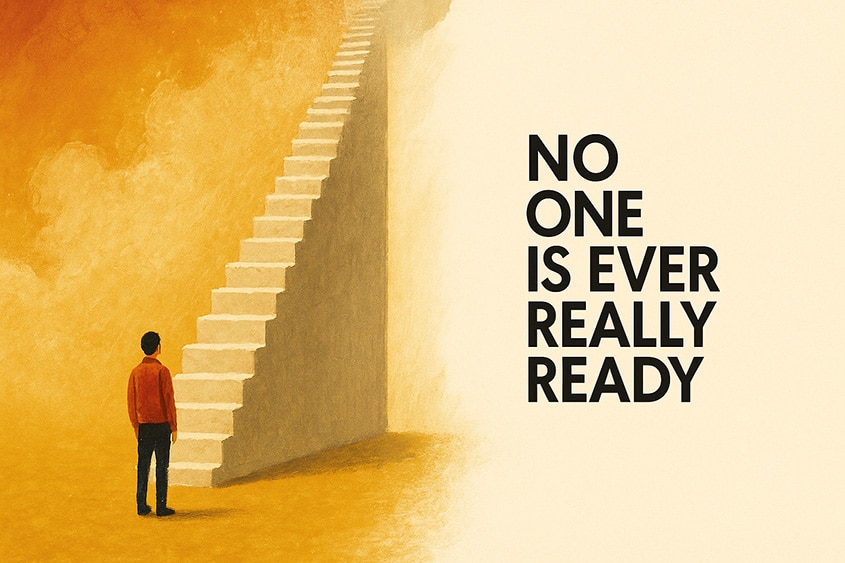
You Don’t Have to Be Ready
Let me tell you a secret: no one is ever really ready for the thing that will change their life. You don’t become ready by waiting, by preparing more, by getting all your ducks in a row. You become ready by starting.
You are waiting for readiness to start. Without realising that you become ready by starting.
Every successful person I know—every leader who’s created something meaningful, every entrepreneur who’s built something lasting, every person who’s made a significant change—they all started before they were ready.
They started:
- Scared
- Uncertain
- With incomplete information
- With imperfect plans
But they started.
An Invitation, Not a Demand
I’m writing this to help you understand what’s happening in your brain so you can make a conscious choice instead of an unconscious one.
If you decide that now isn’t the right time, that’s okay. If you decide that the dream isn’t worth the discomfort, that’s your choice to make.
But I want you to make that choice consciously, not because your brain hijacked the decision-making process.
And if you do decide to move forward, I want you to know that you don’t have to do it alone. You don’t have to figure it all out by yourself. You don’t have to be perfect or have all the answers.
You just have to be willing to take the next step.
The Dream Is Still There
Here’s what I know about you: the dream that showed up in our conversation is still there. The vision you had, the excitement you felt, the clarity you experienced—that wasn’t fake. That wasn’t a moment of delusion. That was you catching a glimpse of who you really are and what you’re really capable of.
Remember:
- The fear might have dimmed that light, but it hasn’t extinguished it. It’s still there, waiting for you to fan it back into a flame.
- The committee in your head is loud, but it’s not the only voice. There’s another voice—quieter, gentler, but infinitely wiser
- It’s the voice that brought you to our conversation in the first place. It’s the voice that knows what you’re capable of
Listen to that voice. Trust that voice. Follow that voice.
And when you’re ready—not when you’re fearless, but when you’re ready to move forward despite the fear—I’ll be here. Not to judge you or pressure you or make you feel guilty, but to remind you of what’s possible and to help you take the next step.
Your dream is still valid. Your vision is still real. Your future is still waiting.
And I’m still here, ready to help you create it.
The only question is: are you ready to stop talking yourself out of it?
Leave a Reply