
How shifting from “what you do” to “what it does for them” transforms sales, leadership, and trust
A CEO I work with runs a successful industrial manufacturing company. His team knows the product inside out. They hit their numbers. But he kept running into the same problem: his salespeople couldn’t articulate value in a way that made customers lean in.
“They’re technically competent,” he told me. “But when they talk to prospects, something falls flat. It sounds transactional. Forgettable.”
I asked what they typically say. He laughed. “Exactly what we do. ‘We manufacture industrial pipes.’ Or ‘We provide piping solutions for commercial buildings.’ And the customer nods politely and moves on to the next vendor.”
The issue wasn’t what they were saying—it was how they were saying it.
What this CEO’s team lacked wasn’t product knowledge. It was communicative depth.
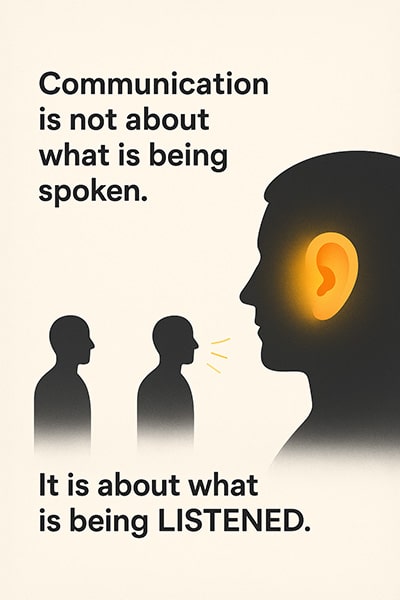
Because communication is not about what is spoken. It is about what is being LISTENED.
When two people are talking, all the power lies in the LISTENER. When you understand this, you understand communication.
And it’s not just a sales problem. It’s a leadership problem. A human connection problem.
Most professionals—whether they’re selling, leading, or just introducing themselves at a conference—operate at the surface level of communication. They describe what they do, not why it matters.
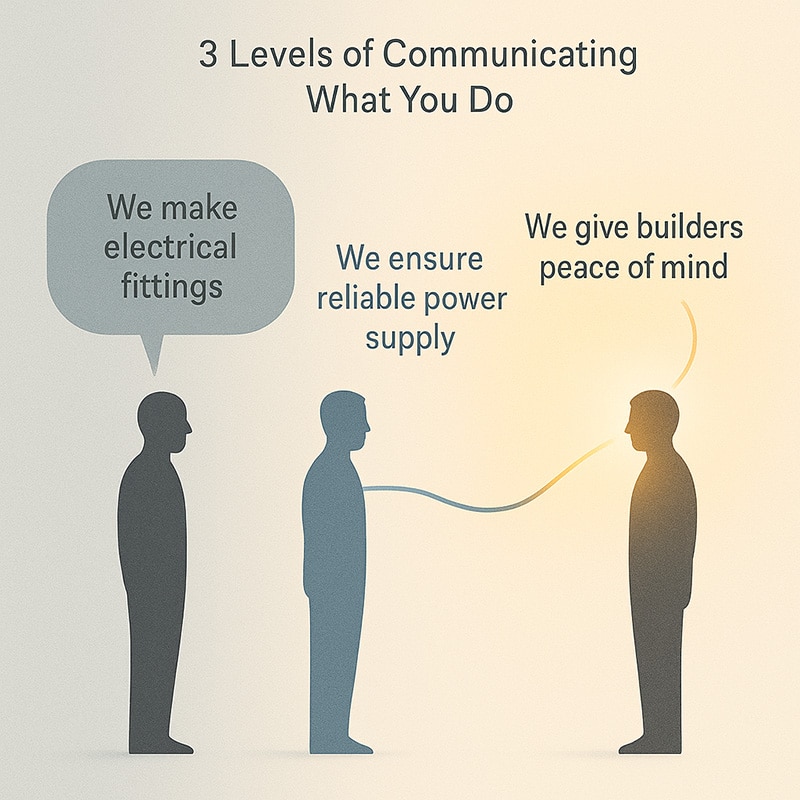
But there’s a framework that changes this. Three levels of communication that, when mastered, transform how people perceive you, trust you, and choose to work with you.
Level 1: What You Do
This is where most people stop.
It’s the job title. The function. The category.
- “I’m a financial advisor.”
- “I run a marketing agency.”
- “We manufacture components for the automotive industry.”
It’s accurate. It’s safe. But it’s also invisible.
When you communicate at Level 1, you sound like everyone else in your field. You’re describing the work, not the value. You’re naming the category, not the outcome.
The problem? Categories don’t create differentiation. And they certainly don’t inspire action.
The risk: You commoditize yourself before the conversation even begins.
Level 2: What You Do For Them
This is where things shift.
Instead of talking about yourself, you pivot toward the person you’re speaking to. You introduce specificity and relevance.
- “I help families plan their finances so they can retire comfortably.”
- “We design marketing campaigns that help B2B companies generate qualified leads.”
- “We provide end-to-end piping systems for commercial buildings—from design to installation.”
Notice what changes: the listener can now see themselves in the picture. You’ve moved from describing a function to articulating an application.
You’re no longer just a financial advisor—you’re someone who helps people grow their assets. You’re not just a marketer—you’re someone who solves a revenue problem.
Why it works: People don’t buy what you do. They buy what it does for them.
But even this isn’t enough.
Level 3: What What-You-Do Does For Them
This is the level where trust is built. Where emotional resonance happens. Where people stop seeing you as a vendor and start seeing you as a partner.
It’s not just what you do for them—it’s what that outcome enables in their life or business.
Let’s revisit those examples:
- “I help families plan their finances so they can retire comfortably” becomes → “I help people sleep peacefully at night, knowing their future is secure.”
- “We design marketing campaigns that generate qualified leads” becomes → “We help companies grow predictably, so leaders can stop worrying about where the next deal is coming from.”
- “We provide end-to-end piping systems for buildings” becomes → “We make sure when you’re building something, you never have to worry about leaks, fittings, or supply delays—you can focus on delivering your project smoothly and confidently.”
See the shift?
You’re no longer selling pipes. You’re selling peace of mind.
You’re not offering financial planning. You’re offering security.
You’re not just generating leads. You’re creating predictability.
This is where great communicators live. They understand that people don’t make decisions based on logic alone—they make them based on how something makes them feel.
And feelings are born from outcomes, not features.
Why Most Leaders Never Get Here
Level 3 requires something most organizations don’t prioritize: empathy.
It requires you to understand—deeply—what your customer, your team, or your stakeholder actually wants. Not what they say they want in a requirements doc. Not what’s in the RFP. But what they lie awake thinking about at 2 a.m.
- A CFO doesn’t just want a financial forecast. They want confidence in the board meeting.
- An operations manager doesn’t just want a vendor. They want someone who won’t let them down when it matters.
- A new client doesn’t just want a consultant. They want someone who gets it without them having to explain everything.
When you communicate at Level 3, you stop selling and start connecting and listening. And when you connect, selling happens naturally.
Practical Application: Give It a Shot
Here’s how to apply this in your own work:
Step 1: Write down what you do. One sentence. That’s Level 1.
Step 2: Ask yourself: What do I do for them? Rewrite it.
Step 3: Go deeper. Ask: What does that do for them? What’s the real impact on their life, their team, their sleep, their confidence, their results? Rewrite again.
You’ll end up with something that feels more alive. More human. Something that makes people stop scrolling, stop half-listening, and actually pay attention.
Examples Across Industries
A real estate agent:
- Level 1: “I help people buy and sell homes.”
- Level 2: “I help families find the right home for their budget and lifestyle.”
- Level 3: “I help families find that one place where they’ll build memories, raise kids, and feel safe.”
A SaaS company:
- Level 1: “We sell project management software.”
- Level 2: “We help teams manage tasks and deadlines more efficiently.”
- Level 3: “We help teams stop drowning in chaos so they can focus on doing their best work.”
A leadership coach:
- Level 1: “I’m a leadership coach.”
- Level 2: “I help executives develop their leadership skills.”
- Level 3: “I help leaders rediscover confidence in who they are and what they’re capable of.”
Every time you move up a level, you move closer to the heart of what people actually care about.
What Changed for the CEO
When I walk my clients through this framework, they often go quiet for a moment. And they see the simplicity and power of the framework – almost like an ‘aha’ moment.
My client’s sales team wasn’t failing because they didn’t know the product. They were failing because they couldn’t translate what they did into something that mattered to the customer.
Most of us make the same mistake.
We get stuck in the “what.” We forget the “why.”
But when you learn to climb these three levels—from what you do, to what you do for them, to what that enables for them—everything changes.
People listen differently. Conversations open up. Trust builds faster.
And honestly? It just feels better.
Because deep down, we all want the same thing—to be understood.
And that’s exactly what this kind of communication does.
It makes you understood.
And that’s where connection—and trust—begin.
Give this a shot. Genuinely. Not as a tactic. You’ll see the difference.
Leave a Reply