
I still remember the moment that changed everything.
It was my first year of college when I discovered what my parents had been hiding from me. My mother had cancer—a battle she’d been quietly fighting while they took loans to send me to engineering school.
As the truth unfolded, I learned something that would forever alter my understanding of love and leadership: my parents had been redirecting money that could have funded my mother’s treatment to pay for my tuition instead.
I witnessed what’s possible when love outruns logic. My parents’ sacrifice wasn’t just about education or even family duty—it was a profound demonstration of what it means to approach life from a “bringing to” rather than a “getting from” mindset.
This distinction—between bringing to and getting from—has become the cornerstone of my life’s work. Everything I do now, and until I die, is to show people what is possible: not just tangible business success, but deeper human possibilities—loving boldly, caring deeply, speaking authentically, and standing unapologetically for their beliefs.
In this article, I’ll share how this fundamental shift in BEING can transform not only how you lead but how you live. Drawing from research, real-world examples, and personal experience, I’ll offer a roadmap for leaders who want to make a genuine difference in their organizations and beyond.
My message is simple but profound: Your dreams and ambitions are within reach; you do not have to wait to live them. And it begins with understanding the power of this DISTINCTION: bringing to versus getting from.
The Fundamental Distinction: Understanding Bringing To vs. Getting From
The Hidden Paradigm That Shapes Everything
Most of us have been conditioned to approach life—both personal and professional—with an unconscious focus on what we can get. We seek validation, recognition, satisfaction, and fulfillment from outside ourselves. When we don’t receive what we’re looking for, we often conclude there’s something wrong with the relationship itself.
This “getting from” state of BEING is so deeply ingrained that we rarely question it. It’s the water we swim in, the air we breathe. But what if there’s another way?
The “bringing to” state of BEING flips this paradigm entirely. Instead of asking “What can I get from this person, team, or situation?” you ask “What can I bring or contribute?” This isn’t about self-sacrifice or martyrdom.
It’s about recognizing that the most fulfilling and effective way to lead—and live—is to approach each interaction with a focus on contribution rather than taking.
The Research: Why This Matters
Wharton professor Adam Grant’s groundbreaking research confirms the power of this shift. In his extensive studies on workplace dynamics, Grant identified three reciprocity styles: givers, takers, and matchers. What he discovered was surprising—givers, those who contribute to others without expecting immediate returns, are found at both the bottom AND the top of success metrics across industries.
The difference? The most successful givers are strategic about how, when, and to whom they give. They don’t give indiscriminately or at the expense of their own well-being. Instead, they bring their best to each interaction while maintaining healthy boundaries.
This research aligns perfectly with my own experience. When my parents chose to redirect funds from cancer treatment to my education, they weren’t being martyrs. They were making a profound statement about what they valued most—the future they wanted to help create through me. Their giving wasn’t about self-denial; it was about self-expression of their deepest values.
The Personal Cost of Getting From
I’ve seen firsthand the toll that a “getting from” state of BEING takes on leaders. Early in my career, I worked with a CEO who approached every interaction with the question “What can I get here?” His leadership created a culture of fear, withholding, and ultimately, stagnation. Employees protected their ideas, hoarded resources, and focused on survival rather than innovation.
The irony was painful to watch: the more he tried to extract, the less value there was to extract. His company eventually lost market share to more innovative competitors, and he was replaced by the board. The personal cost was even higher—strained relationships, health issues from chronic stress, and a legacy defined by what he took rather than what he gave.
Contrast this with leaders like Satya Nadella, who took over as CEO of Microsoft when the company was struggling with internal competition and market challenges. Nadella instituted a fundamental shift from a “know-it-all” culture to a “learn-it-all” culture—essentially moving from a “getting from” to a “bringing to” paradigm.
This transformation wasn’t smooth; there were numerous setbacks and resistance. But Nadella’s persistence in modeling curiosity, empathy, and a growth mindset eventually transformed the company. Since this cultural shift, Microsoft’s market value has increased by over 600%.
The Journey: My Moment of Truth
My own journey from “getting from” to “bringing to” wasn’t a smooth one. After college, driven partly by my parents’ sacrifice, I pursued success with singular focus. I climbed the corporate ladder quickly, but something felt hollow about my achievements.
I remember the exact moment this paradigm shift became clear to me. I was leading a high-stakes project with an impossible deadline. The pressure was immense, and I found myself increasingly frustrated with my team. In my mind, I wasn’t getting the performance, the commitment, or the creativity I needed from them.
During one particularly tense meeting, I caught myself thinking, “Why aren’t they giving me what I need to succeed?” And then it hit me—I had been approaching leadership as a transaction where my role was to extract value from my team. I was coming to work each day focused on what I could get from others rather than what I could bring to them.
That night, I made a decision to flip the script. Instead of asking “What am I getting from my team?” I started asking “What am I bringing to my team?” The next morning, I walked in with a fundamentally different energy. I wasn’t there to extract performance—I was there to bring support, clarity, and genuine appreciation for each person’s unique contributions.
The transformation wasn’t immediate, but it was unmistakable. Within weeks, the same team that I had labeled as underperforming was exceeding expectations. The project that seemed doomed became our division’s greatest success story that year. But the most profound change wasn’t in my team—it was in me. I discovered that leadership satisfaction doesn’t come from what you get; it comes from what you give.
The Pain That Drives Purpose
It pains me deeply to meet people with a dream in their eyes who believe it’s impossible. I see in them the same potential my parents saw in me—possibilities that might never be realized if they remain trapped in a “getting from” mindset.
This pain has shaped everything I do today. My life is a stand for possibility—love, peace, ambition, meaning, full aliveness right now. Not someday. Not when conditions are perfect. Right now.
When I share my parents’ story, people often ask if I feel guilty about the sacrifice they made. The truth is more complex. I feel a profound responsibility to honor their gift by living fully and helping others do the same. Their sacrifice showed me what’s possible when love outruns logic, and that lesson has shaped every aspect of my leadership approach.
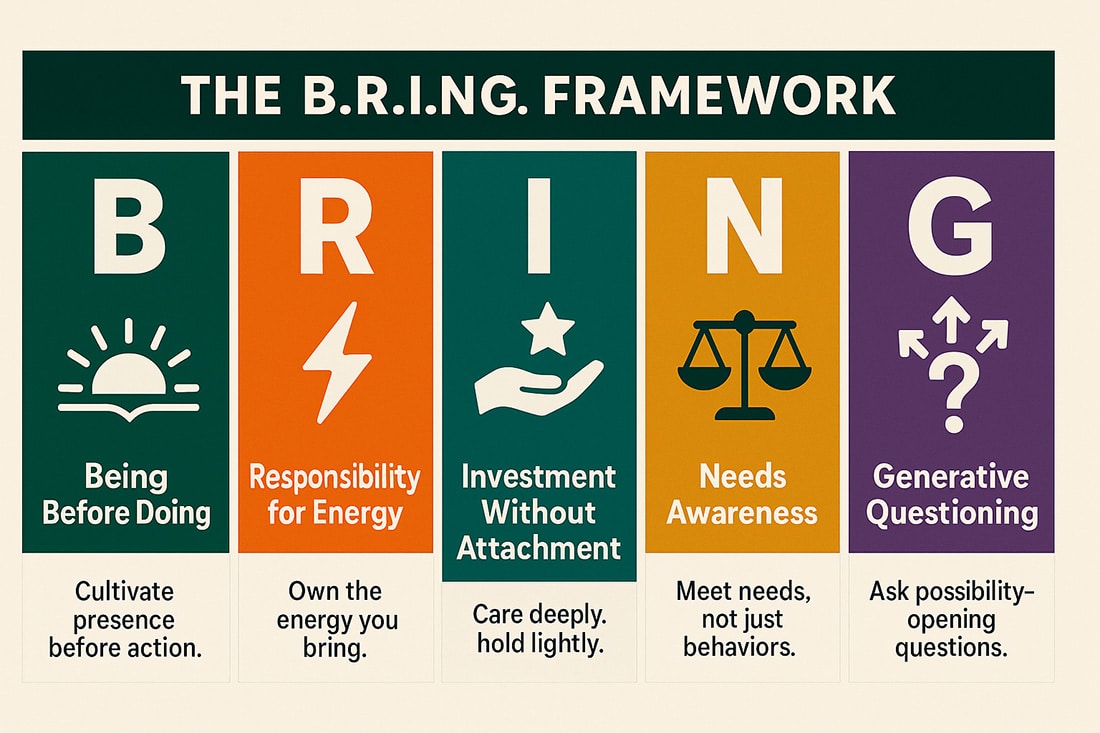
The B.R.I.N.G. Framework: A Practical Guide for Leaders
To help leaders practice this DISTINCTION and shift their BEING, I’ve developed the B.R.I.N.G. Framework—five practical dimensions of the “bringing to” leadership paradigm that you can implement starting today:
B – Being Before Doing
The “bringing to” BEING begins with who you are, not what you do. Before you can bring your best to others, you must cultivate your own internal BEING. This means developing self-awareness and knowing what you stand for.
Many leaders believe that “practice makes perfect,” but that’s an oversimplification. Mindless practice only reinforces existing patterns. The truth is that “conscious practice makes progress.” Daily reflection on how you’re showing up—not just what you’re getting done—is essential.
ACTIONABLE STEP: Begin each day with a 5-minute reflection on your leadership intention. Ask yourself: “Who do I want to be for my team today?” rather than just “What do I need to accomplish?”
PERSONAL EXAMPLE: After my mother passed away, I found myself going through the motions of leadership—present physically but absent emotionally.
After 8 years of her passing away and going through mild-depression, I created a morning ritual where I would look at her photo and ask myself, “How would she want me to show up today?” This simple practice transformed my presence as a leader, helping me quit my 16-year tech career and start the Deploy Yourself School of Leadership
R – Responsibility for Energy
Energy is contagious, and as a leader, yours sets the tone. The “bringing to” leader takes full responsibility for the energy they bring into every interaction. This doesn’t mean being artificially positive; it means being intentional.
Before every meeting, every conversation, ask yourself: “What energy am I bringing to this interaction? Is it aligned with my highest intentions for this relationship?”
ACTIONABLE STEP: Create an “energy check” ritual before important meetings. Take 30 seconds to assess your current emotional state and consciously choose the energy you want to bring. Studies from the Center for Creative Leadership show that teams whose leaders practice emotional regulation are 67% more likely to maintain high performance during stressful periods.
PERSONAL EXAMPLE: During a particularly challenging company restructuring while at Booking.com, I noticed my anxiety was affecting my team’s confidence. I started taking five deep breaths before entering any meeting, consciously releasing tension and connecting with my commitments. Team members later shared that my calm presence during that period was what enabled them to navigate the uncertainty productively.
I – Investment Without Attachment
Bring your full investment to relationships and outcomes, but practice non-attachment to specific responses or results. This paradoxical approach—caring deeply while holding lightly—creates space for others to step into their own power.
When you’re attached to getting a particular response, people sense it and often resist. When you bring your best without attachment, you create psychological safety that allows others to bring their best as well.
ACTIONABLE STEP: When delegating an important task, clearly communicate your investment in both the person and the outcome, then explicitly give them autonomy: “I trust your judgment on how to approach this.” McKinsey’s research shows that this combination of support and autonomy increases innovation by 41% and employee satisfaction by 53%.
PERSONAL EXAMPLE: I learned this lesson painfully when launching a new software revamp. I was so attached to the project that I micromanaged the team, creating resentment and stifling creativity. When I finally stepped back and said, “I trust you to make this great in your own way,” the team exceeded my original vision with innovations I never would have conceived.
N – Needs Awareness
Understand that all behavior—yours and others’—is an attempt to meet fundamental human needs. The “bringing to” leader develops literacy in identifying these needs and addresses them directly rather than reacting to surface behaviors.
When a team member is underperforming, instead of asking “How do I get better performance?” ask “What needs might be unmet that are affecting their ability to contribute fully?”
ACTIONABLE STEP: In your next one-on-one meeting with a team member, use the “needs conversation” approach. Ask: “On a scale of 1-10, how well do you feel your needs for autonomy, mastery, and purpose are being met in your current role?” Then explore specific ways you can help address any gaps. Google’s Project Aristotle research identified psychological safety as the #1 predictor of team effectiveness, and needs-based conversations are a primary builder of that safety.
PERSONAL EXAMPLE: One of my most valuable team members was becoming increasingly withdrawn in meetings. Rather than focusing on the behavior, I invited her to coffee and asked about her needs.
She revealed that she felt her expertise wasn’t being utilized in our current project. By restructuring her role to leverage her strengths, not only did her engagement return, but she delivered breakthrough insights that significantly improved our product.
G – Generative Questioning
The questions we ask shape the reality we create.
“Getting from” leaders ask: “What’s wrong?” “Who’s to blame?” “How do we fix this?”
“Bringing to” leaders ask generative questions that open possibilities: “What’s trying to emerge here?” “What would make this relationship thrive?” “How can I support your highest potential?”
The quality of your life is determined by the quality of the questions you habitually ask yourself and others.
ACTIONABLE STEP: Create a “question transformation” practice for your team. Identify the three most common problem-focused questions in your organization and reframe them as opportunity-focused questions. For example, change “Why are we behind schedule?” to “What would enable us to accelerate our progress?” Research from the Appreciative Inquiry field shows that this simple shift can increase solution generation by 300%.
Real-World Example: The Bringing To Mindset in Action
The Founder Who Built Giving Into Business
When Blake Mycoskie founded TOMS Shoes with his “One for One” model—giving a pair of shoes to a child in need for every pair purchased—he wasn’t just creating a charitable business. He was modeling a “bringing to” mindset that transformed consumer expectations across the retail industry.
This ripple effect has inspired hundreds of companies to adopt similar models, collectively bringing billions of dollars in resources to communities in need.
Mycoskie’s approach reminds me that the “bringing to” mindset isn’t just about individual interactions—it can be built into the very DNA of organizations and business models.
Just as my parents’ sacrifice wasn’t a one-time decision but a consistent expression of their values, truly transformative leadership embeds the “bringing to” philosophy into systems and structures.
The Science Behind the Shift
The Psychological Safety Connection
Research from McKinsey confirms the power of the “bringing to” approach. Their global survey found that only a small percentage of business leaders consistently demonstrate the positive behaviors that create psychological safety in their workforce—a critical foundation for innovation and adaptation.
Yet the same research shows that when leaders shift from authoritative styles to more consultative and supportive approaches, team performance dramatically improves.
This research resonates deeply with my experience. When I shifted from focusing on what I could get from my team to what I could bring, I wasn’t just changing my behavior—I was transforming the entire emotional climate of our work environment.
The Neurological Evidence
Recent neuroscience research provides fascinating insights into why the “bringing to” mindset is so powerful. A 2022 study using fMRI technology examined brain activity in leaders practicing different approaches to influence.
When leaders focused on what they could get from others (coercive influence), the brain’s threat response system was activated, triggering the release of cortisol and other stress hormones—not just in the leader, but also in those they were attempting to influence.
In contrast, when leaders focused on what they could bring to others (supportive influence), the brain’s reward system was activated, triggering the release of oxytocin and dopamine—again, in both the leader and those they were influencing.
This neurological evidence suggests that the “bringing to” mindset creates a virtuous cycle of positive brain chemistry that enhances creativity, collaboration, and well-being for everyone involved.
Transforming Teams
While individual leadership transformation is powerful, the true magic happens when entire teams embrace the “bringing to” mindset collectively. When everyone on a team shifts from asking “What can I get?” to “What can I bring?”, the result is exponentially greater than the sum of individual contributions.
The Pixar Example
Consider the remarkable transformation at Pixar Animation Studios. In the early days of developing Toy Story, the team faced numerous technical and creative challenges that could have derailed the project. Instead of focusing on individual credit or blame, they developed a culture of “plussing“—a practice where team members build on each other’s ideas by adding something positive rather than criticizing.
This collective “bringing to” approach not only saved Toy Story but established a creative process that has produced some of the most successful animated films in history.
What strikes me about Pixar’s approach is how it creates a culture where everyone feels both safe and challenged—safe to offer ideas without fear of ridicule, and challenged to continuously improve those ideas. This balance of psychological safety and high standards is the sweet spot where innovation thrives.
This research confirms what I’ve observed in my own teams: When people shift from protecting their individual interests to actively contributing to collective success, performance improves dramatically. But more importantly, work becomes more meaningful and fulfilling for everyone involved.
Actionable Steps for Team Transformation
1. Implement a “Bringing Ritual” at the beginning of team meetings. Have each person briefly share what they’re bringing to the team today—whether it’s a resource, an insight, or simply a supportive presence. Research from MIT’s Human Dynamics Laboratory shows that teams that practice such check-ins experience 30% higher productivity and 50% higher satisfaction.
2. Create a “Team Bringing Agreement” with your group. Together, identify 3-5 specific ways team members commit to bringing value to each other and to stakeholders. Review and renew this agreement quarterly.
3. Establish “Bringing Metrics” alongside traditional performance metrics. Measure and celebrate not just what team members achieve, but how they contribute to others’ success. This might include tracking instances of knowledge sharing, cross-functional support, or mentoring.
The Ripple Effect: Beyond Your Organization
The impact of the “bringing to” state of BEING extends far beyond your immediate team or organization. As you embody this approach, you create ripple effects that influence your industry, community, and even society at large.
My Personal Ripple Effect
When I think about the ripple effects of my parents’ sacrifice, I’m humbled and inspired. Their decision to prioritize my education over my mother’s treatment wasn’t just about me—it was about everything has happened in my life since then. They couldn’t have known exactly how their sacrifice would ripple outward, but they trusted that it would.
In the same way, when we lead from a “bringing to” mindset, we create ripples that extend far beyond what we can see or measure. Every person who experiences your leadership carries that experience into other relationships and contexts. Every team that thrives under your guidance becomes a model for other teams. Every organization that embodies this philosophy influences its industry and community.
Actionable Steps for Creating Positive Ripples
1. Identify one “bringing opportunity” beyond your organization’s boundaries. This could be mentoring emerging leaders in your industry, sharing best practices with peer organizations, or addressing a community need related to your expertise.
2. Create a “Bringing Beyond” initiative that encourages and supports employees in applying their skills to community or industry challenges. This could include paid volunteer time, skills-based volunteering programs, or collaborative projects with nonprofit organizations.
3. Share your “bringing to” journey openly with other leaders. By vulnerably discussing both the challenges and benefits of this shift in BEING, you inspire others to consider their own approach. Leadership transparency has been shown to accelerate positive cultural change across organizational boundaries, according to research from the MIT Sloan School of Management.
Overcoming Challenges: When Bringing To Gets Tough
The journey from “getting from” to “bringing to” isn’t always smooth. There are real challenges and potential pitfalls along the way. Acknowledging these challenges is essential for sustainable transformation.
The Challenge of Boundaries
One of the most common concerns about the “bringing to” mindset is the fear of being exploited or burning out. This is a legitimate concern—giving indiscriminately without boundaries can indeed lead to depletion and resentment.
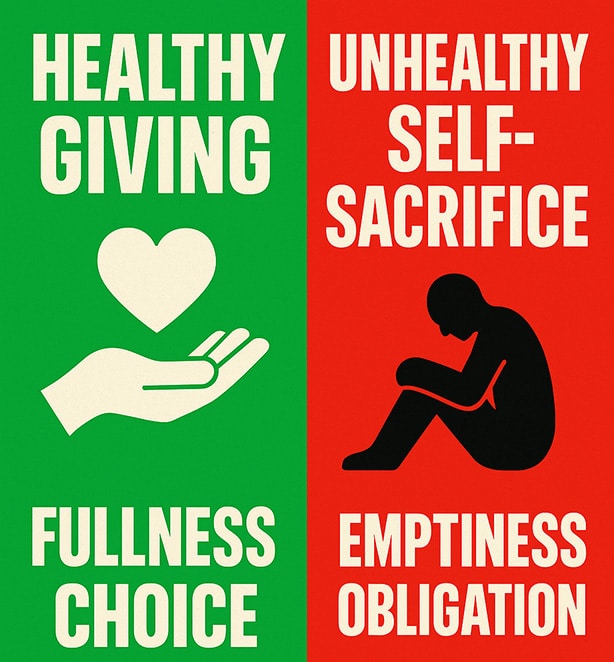
The key is to distinguish between healthy giving and unhealthy self-sacrifice. Healthy giving comes from a place of fullness and choice; unhealthy self-sacrifice comes from a place of emptiness and obligation.
PERSONAL EXAMPLE: After my mother’s passing, I initially honored her memory by saying yes to everyone who needed help, regardless of the cost to my own well-being. I was trying to replicate her sacrifice, but I was doing it from a place of grief and obligation rather than love and choice. The result was predictable: burnout, resentment, and diminished effectiveness as a leader.
The turning point came when I realized that true “bringing to” leadership requires self-care as a foundation. I couldn’t bring my best to others if I was depleted and resentful. Setting healthy boundaries wasn’t a betrayal of my mother’s legacy—it was the only way to truly honor it by sustaining my capacity to give over the long term.
When I put myself first, I can serve others best.
The Challenge of Organizational Culture
Another significant challenge arises when you’re attempting to embody the “bringing to” mindset within an organization that operates primarily from a “getting from” paradigm. This misalignment can create tension and even career risks.
PERSONAL EXAMPLE: Early in my career, I worked in an organization with a highly competitive, zero-sum culture. When I began shifting to a more generous, collaborative approach, I faced skepticism and even ridicule from peers who saw my behavior as naive or strategically unwise.
Rather than abandoning my approach or leaving immediately, I focused on creating a micro-culture within my team while strategically demonstrating the business value of the “bringing to” mindset. Over time, our team’s superior results spoke for themselves, and other leaders began to take notice and ask questions. What began as a small pocket of cultural change eventually influenced the broader organization.
ACTIONABLE STEP: Identify a “bringing to” ally within your organization—someone who shares your values or is open to this approach.
The Challenge of Consistency
Perhaps the most persistent challenge is maintaining consistency in the “bringing to” state of BEING, especially under pressure. When stakes are high, deadlines are looming, or resources are scarce, it’s easy to slip back into a “getting from” approach.
PERSONAL EXAMPLE: During a particularly stressful period, I found myself reverting to command-and-control leadership, focusing more on what I needed from my team than what I could bring to them. The impact was immediate and negative—trust eroded, creativity diminished, and progress slowed.
Recognizing this pattern, I created a simple practice: whenever I felt myself slipping into “getting from” mode, I would pause and ask, “What could I BRING TO this situation?” This question immediately reconnected me with my deeper values and shifted my focus back to contribution rather than extraction.
ACTIONABLE STEP: Create a personal “stress trigger plan” that identifies: 1) Early warning signs that you’re slipping into a “getting from” mindset, 2) A specific pause practice to interrupt this pattern, and 3) A reconnection question that brings you back to your core values.
The Ultimate Transformation: From Success to Significance
As powerful as the “bringing to” mindset is for achieving traditional success metrics, its greatest impact may be in transforming how we define success itself. When we shift from getting to bringing, we often experience a parallel shift from pursuing success to creating significance.
Redefining Success
For much of my early career, I defined success in conventional terms—advancement, recognition, financial rewards. These aren’t inherently negative goals, but they created a perpetual sense of striving without arriving. There was always another level to reach, another achievement to pursue.
My parents’ sacrifice taught me a different definition of success—one based on contribution rather than acquisition. They didn’t measure their lives by what they accumulated but by what they gave. Their success wasn’t visible on a balance sheet or resume, but it was profound and lasting.
As I’ve embraced the “bringing to” DISTINCTION more fully, my own definition of success has evolved. I still value achievement and results, but they’re no longer the primary metrics by which I measure my life and leadership. Instead, I ask questions like:
- How have I helped others grow and thrive?
- What positive impact have I created beyond myself?
- Am I living in alignment with my deepest values?
- Am I fully present and alive in this moment?
This shift doesn’t diminish ambition—it transforms it. My ambition now is not just for personal achievement but for collective flourishing. I want to succeed not just by conventional metrics but by creating meaningful value for others.
From Transaction to Transformation
The ultimate power of the “bringing to” mindset is its ability to transform relationships from transactional to transformational. When we approach interactions with a focus on what we can bring rather than what we can get, we create space for genuine connection and mutual growth.
PERSONAL EXAMPLE: In the aftermath of my mother’s passing, I initially approached my grief as something to “get through”—a challenge to overcome so I could get back to normal functioning. This “getting from” approach to grief left me feeling stuck and isolated.
The breakthrough came when I shifted to asking what I could bring to my grief—presence, compassion, patience, and eventually, meaning-making. This shift didn’t make the pain disappear, but it transformed my relationship with it. My grief became not just a burden to bear but a teacher that deepened my capacity for empathy and connection with others.
This same transformation is possible in all our relationships—with colleagues, team members, customers, and communities. When we shift from asking “What can I get from this relationship?” to “What can I bring?”, we create the conditions for genuine transformation.
The Legacy Question
Perhaps the most profound shift that occurs when we embrace the “bringing to” mindset is in how we think about legacy. Legacy isn’t something that begins at the end of our career or life—it’s being created in every interaction, every decision, every day.
My parents didn’t set out to create a legacy through their sacrifice. They were simply expressing their deepest values in a moment of difficult choice. Yet their decision has rippled outward in ways they couldn’t have fully imagined, touching countless lives through my work and the work of those I’ve influenced.
In the same way, your legacy as a leader is being written not primarily through your achievements but through your contributions—the value you bring to others and the positive impact you create. This legacy isn’t measured in quarters or even years but in generations.
ACTIONABLE STEP: Create a “legacy journal” where you regularly reflect on three questions:
- What am I bringing to my relationships and work today?
- How might these contributions ripple outward beyond what I can see?
- What values do I want my actions to express and perpetuate?
A Call to Possibility: Your Dreams Are Within Reach
We stand at a critical inflection point in the evolution of leadership. The old paradigm of “getting from”—extracting value, maximizing personal gain, and measuring success by what we accumulate—has reached its limits. It’s creating burnout, disengagement, and a profound sense that something essential is missing from our work lives.
The “bringing to” paradigm offers not just a more fulfilling approach to leadership, but a more effective one. The research is clear: leaders and organizations that focus on contribution rather than taking outperform their peers on virtually every meaningful metric—from innovation and adaptability to talent retention and long-term financial performance.
But beyond the business case, there’s a deeper truth: we are at our best, most alive, and most fulfilled when we’re bringing our gifts rather than focused on what we’re getting. This isn’t just good leadership; it’s good living.
It pains me to meet people with a dream in their eyes who believe it’s impossible. I see in them the same potential my parents saw in me—possibilities that might never be realized if they remain trapped in a “getting from” mindset.
My life is a stand for possibility—love, peace, ambition, meaning, full aliveness right now. Not someday. Not when conditions are perfect. Right now.
Your dreams and ambitions are within reach; you do not have to wait to live them. The shift from “getting from” to “bringing to” is the key that unlocks not just greater success but deeper fulfillment and more meaningful impact.
As you leave this article, I invite you to take three specific actions and then reach out and share with me what happened:
- Start with one relationship: Identify one important professional relationship and consciously shift from “What am I getting?” to “What am I bringing?” Notice what changes.
- Transform your team: Introduce the B.R.I.N.G. Framework to your team and implement at least one of the actionable steps we’ve discussed. Measure the impact over 90 days.
- Expand your influence: Share this paradigm shift with at least one peer leader. The more we spread this approach, the more we transform not just our organizations but our communities and society.
Remember, this journey isn’t about perfection—it’s about practice. You’ll have days when you slip back into old patterns. That’s not failure; it’s part of the process. What matters is your commitment to return, again and again, to the fundamental question: “What am I bringing today?”
The world is waiting for leaders who understand that true power comes not from what we take, but from what we give. Will you be one of them?
About Me (Sumit)
Everything I do—now and until I die—is to show people what is possible: not only tangible business success but deeper human possibilities: loving boldly, caring deeply, speaking authentically, standing unapologetically for their beliefs.
Today, I work with leaders and organizations to help them shift from a “getting from” to a “bringing to” mindset, unlocking greater success, fulfillment, and positive impact. My approach combines rigorous research, practical frameworks, and authentic personal narrative to create transformative learning experiences.
I believe that leadership is not primarily about position or power but about contribution and impact. The leaders who make the greatest difference are those who focus not on what they can get, but on what they can bring.
If you’d like to continue this conversation or explore how the “bringing to” mindset might transform your leadership and organization, please reach out. Together, we can create ripples of positive impact that extend far beyond what either of us might accomplish alone.
Leave a Reply