
Most people treat coaching like a spa day—a pleasant escape that temporarily feels good before returning to business as usual. But real transformation requires a fundamentally different approach.
The Truth Nobody Wants to Hear
Early in my coaching journey, my coach told me something that changed everything: “Nobody is coming to save you.”
It felt brutal at first. But it was the best news I could receive—because it meant the power to change was entirely within me. The coach isn’t there to fix you; they’re there to challenge you and hold up a mirror to what you’re creating.
The Difference Between Dabbling and Commitment
Why Comfort Is the Enemy of Growth
We’re naturally drawn to comfort—to situations, people, and environments that affirm our existing self-concept and behaviors. But this comfort, while pleasant, is fundamentally incompatible with transformation.
Significant development happens not in your comfort zone but at its edge—where you feel stretched but not broken, challenged but not threatened.
The most successful coaching clients understand this paradox: the discomfort they feel in coaching isn’t a sign that something’s wrong but that something’s working. They learn to distinguish between productive discomfort (which signals growth) and unproductive distress (which signals harm).
The real value of coaching is in how you choose to listen, perceive, and act. It’s not in the coach’s wisdom, but in your commitment to growing as a leader.
Research from Harvard Business Review confirms what I’ve seen in practice: when motivation comes from external sources—a coach’s directives, incentives, or threats—commitment to change is short-lived.
True transformation only happens when you recognize that:
- You are already creating the results in your life and business, whether consciously or not
- The coach isn’t there to fix things but to illuminate what you’re creating
- The power to change your circumstances exists entirely within you
The Courage to Be Uncomfortable
Ultimately, getting the most from coaching requires the courage to be uncomfortable—to voluntarily step into the discomfort of growth rather than remaining in the familiarity of limitation.
This courage isn’t about fearlessness. It’s about feeling the fear and moving forward anyway, trusting that the discomfort of growth serves your larger purpose and potential.
Remember: The moments in coaching that feel most uncomfortable often hold the greatest potential for transformation. Your willingness to lean into productive discomfort—supported by appropriate safety—may be the single most important factor in what you gain from the coaching relationship.
The Ultimate Mindset Shift
The most powerful approach to coaching isn’t asking “What can my coach give me?” but rather “Who must I become to create the results I want?”
This shift from getting to becoming is what separates those who use coaching as a temporary boost from those who experience genuine transformation.
The Coachee’s Role: Owning the Process
1. Own Your Results
You’re already producing every result in your life and business—whether you realize it or not. The overwhelm, the revenue, the team dynamics—you’re creating all of it. Coaching simply brings this into conscious awareness so you can create something different.
A founder I coached blamed demanding clients and market volatility for her stress. When asked, “How are you contributing to your own overwhelm?” she realized she was creating it by refusing to set boundaries. Taking ownership changed everything.
2. Show Up Prepared
Preparation determines 80% of your coaching outcomes. Before each session:
- Identify what you’re avoiding: The conversation that makes you most uncomfortable often holds the greatest growth potential
- Find the pattern: What keeps repeating despite different circumstances?
- Raise the stakes: What’s the cost if nothing changes?
- Bring hunger: Connect emotionally to why your growth matters
3. Set Goals That Scare You
Forget SMART goals. Transformational coaching requires TID goals:
- Thrilling: Energizes you at a visceral level
- Important: Serves something greater than yourself
- Daunting: Requires you to grow beyond who you are today
One client didn’t aim to “increase sales by 15%.” She committed to “becoming the kind of leader who builds a million-dollar business while working fewer hours.” That’s the difference.
From Participation to Commitment
Most people participate in coaching. Few commit to transformation. Here’s the difference:
You’re just participating if you:
- Reschedule sessions when work gets busy
- Only implement comfortable suggestions
- Want results without discomfort
- Keep coaching insights separate from daily decisions
You’re committed when you:
- Treat coaching as non-negotiable
- Embrace productive discomfort
- Extend learning between sessions
- Take action even when scared
Let me give you an example: I was coaching a founder who wanted to grow his business from $5M to $10M in annual revenue. At first, he thought it was just a matter of getting better at sales and operations. But through our conversations, he realized that the real challenge was his own fear of stepping up as a leader. He was holding back on making bold decisions because he was afraid of failure and what others might think of him.
Once he took ownership of that fear and realized that he was the one producing the results in his business, things changed. He started leading his team more decisively, took unimaginable risks, and his business started growing—not because of any specific tactic we discussed, but because he shifted how he saw himself as a leader.
Why Preparation Determines 80% of Coaching Outcomes
The quality of your coaching experience depends largely on what you bring to the table. Many people default to surface-level operational issues rather than addressing the deeper patterns that “run” you on autopilot.
To identify your most valuable focus areas, ask yourself these questions during your preparation:
- What conversation am I avoiding? Often, the topic that makes you most uncomfortable holds the greatest potential for growth.
- Where am I feeling friction? Resistance, frustration, or recurring problems usually point to important development areas.
- What’s the problem beneath the problem? If you’re struggling with team performance, the real issue might be your difficulty with direct feedback. If you’re overwhelmed with work, the underlying challenge might be boundary-setting.
- What pattern keeps repeating? Look for situations where you keep getting similar results despite different circumstances.
- What would make the biggest difference? If you could change just one aspect of your leadership or business approach, what would create the most significant impact?
A client who was struggling with work-life balance initially wanted to discuss time management techniques. During her preparation, she realized the real issue wasn’t scheduling but her inability to say no to new opportunities—stemming from a deeper fear of missing out. This insight completely shifted our focus and led to transformative work on her relationship with sufficiency and self-worth.
Material Outcomes: Just Practice for Real Transformation
Most people come to coaching with a desire for specific material outcomes: more revenue, a stronger team, a successful product launch. And while those goals are important, they’re not the real transformation.
The real transformation is your growth as a leader. The material outcomes are just the practice field where you get to see how much you’ve grown. The true value of coaching is the awareness that you can create any outcome, once you fully step into your role as a leader.
Take this story from one of my clients: He came into coaching wanting to double his company’s revenue. But by the end of our work together, he realized the real transformation was in his leadership. He saw that every decision, every result, was a reflection of how he showed up as a leader. Once he stepped into that, the revenue followed naturally. It wasn’t about hitting a number; it was about realizing that he had the power to create any result he wanted.
The Power of Identity-Based Goals
When you set goals that challenge your identity—not just your calendar or your tactics—you create the conditions for genuine transformation. You stop trying to become a slightly better version of your current self and start evolving into someone new.
As one client who published her book and expanded internationally put it: “I realized I wasn’t just trying to write a book. I was becoming someone who expresses her truth boldly, who claims her expertise without apology, who serves through vulnerability rather than perfection. Once I understood that, the writing became the easy part.”
Remember: The most powerful goals aren’t just about what you’ll achieve. They’re about who you’ll become in the process. And that’s where the true magic of coaching lies.

Ultimately, commitment isn’t something that happens to you—it’s a choice you make repeatedly. Each time you face resistance, each time the path becomes difficult, you have a choice: to participate or to commit.
The clients who experience the most profound transformations make this choice consciously. They decide that their development isn’t optional or conditional—it’s essential to who they are becoming.
As one client who took a stand for herself for the first time and drew boundaries with her husband put it: “I realized I had been treating my growth like a hobby—something I did when it was convenient and comfortable. The breakthrough came when I decided it was non-negotiable, as essential as breathing. That’s when everything changed.”
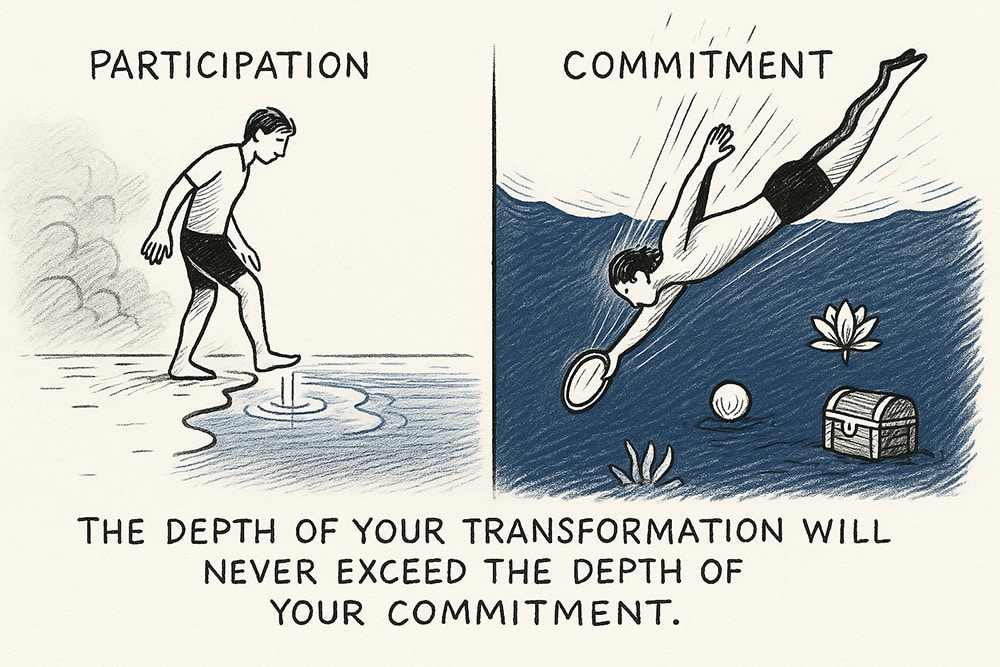
Remember: The depth of your transformation will never exceed the depth of your commitment. When you shift from participation to full commitment, you create the conditions for extraordinary change.
The Power of Integrity: Saying What You Mean, Doing What You Say
At the heart of transformation is integrity: saying what you mean and doing what you say. This isn’t about morality—it’s about power.
When you consistently honor your word:
- You develop unshakeable self-trust
- You build momentum through kept promises
- You clarify what truly matters
- Your commitments become reality
Track every promise you make—to yourself and others. Review them daily. When circumstances change, communicate proactively.
Action Over Insight
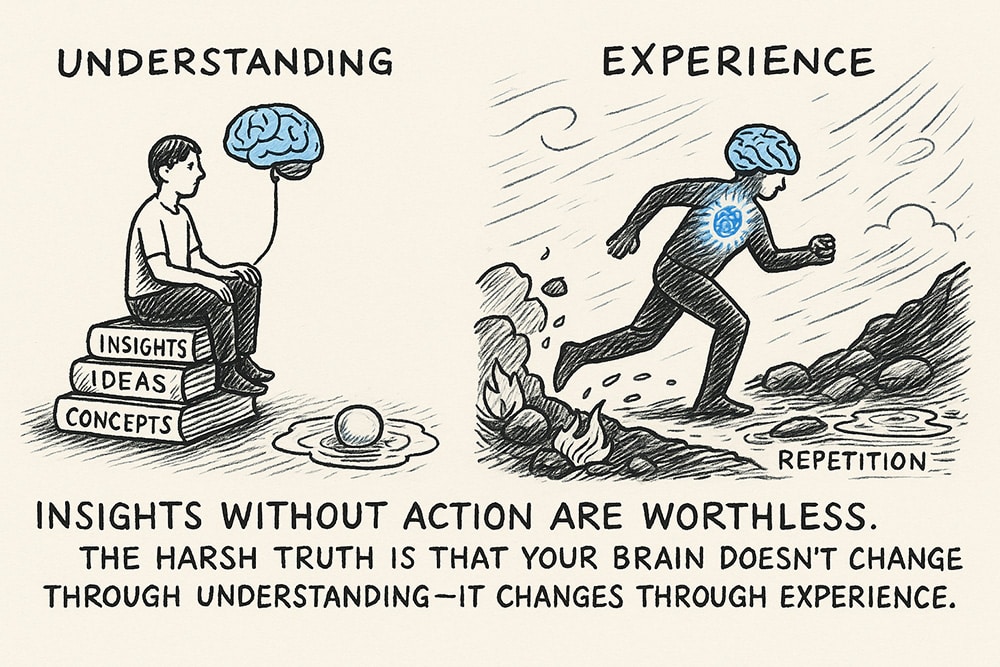
Insights without action are worthless. Your brain doesn’t change through understanding—it changes through experience.
After each session:
- Experiment boldly: Try new behaviors, even imperfectly
- Reflect deeply: What did you do differently? What impact did you observe?
- Document learning: Capture insights to solidify neural pathways
- Share with your coach: Don’t wait until the next session
One client reduced meeting time from 12 to 6 hours daily while doubling team productivity. The transformation wasn’t the metrics—it was who he became as a leader. The metrics just reflected that deeper change.
Remember: The true measure of coaching effectiveness isn’t what happens during sessions but what happens between them. Your commitment to the action-reflection cycle is what transforms coaching from an interesting conversation into a catalyst for profound change.
An absurd and dramatic example
Imagine this: You’re walking through a graveyard. Everything seems lifeless. But as you walk, dead bodies begin to rise out of the ground—one by one, they come to life and start asking to work with you, wanting your leadership and insight.

It sounds absurd, right? Completely impossible.
Yet, this is the exact metaphor I use to explain the power we have as leaders. We all have the ability to “create” something out of nothing by changing how we see ourselves and the world around us. Just as those “dead bodies” in the graveyard seem immobile, the challenges or situations in your business may appear stagnant or impossible to change. But when you realize that you are the source of change, you suddenly have the ability to transform the seemingly impossible into new opportunities.
I know this is an overly dramatic example – but I want to make a point – results like the above are available for you from coaching.
The Final Word: You’re the Creator
Stop asking “What can my coach give me?”
Start asking “Who must I become to create the results I want?“
This shift—from getting to becoming—separates temporary boosts from genuine transformation.
The invitation: Will you show up to coaching not seeking improvement but committed to transformation? Will you bring your full self—challenges, aspirations, fears, power—to the process?
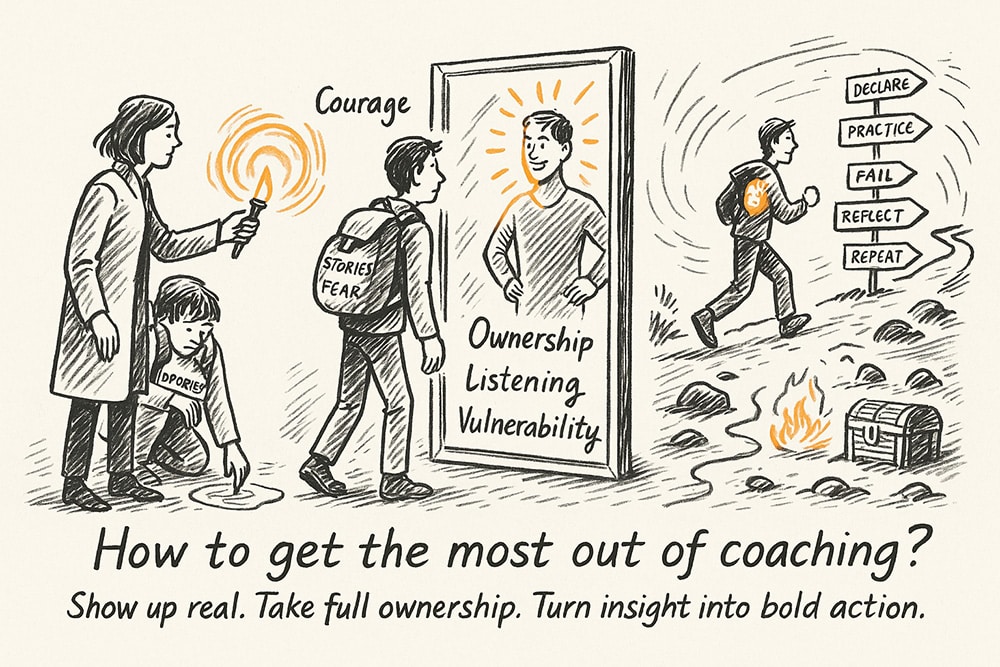
If you do, there’s no limit to what you can create. Not because any coach will give you answers, but because you’ll discover your capacity to generate them yourself.
Remember: The power to transform your business, leadership, and life is already within you. The coach simply helps you discover it.
Leave a Reply